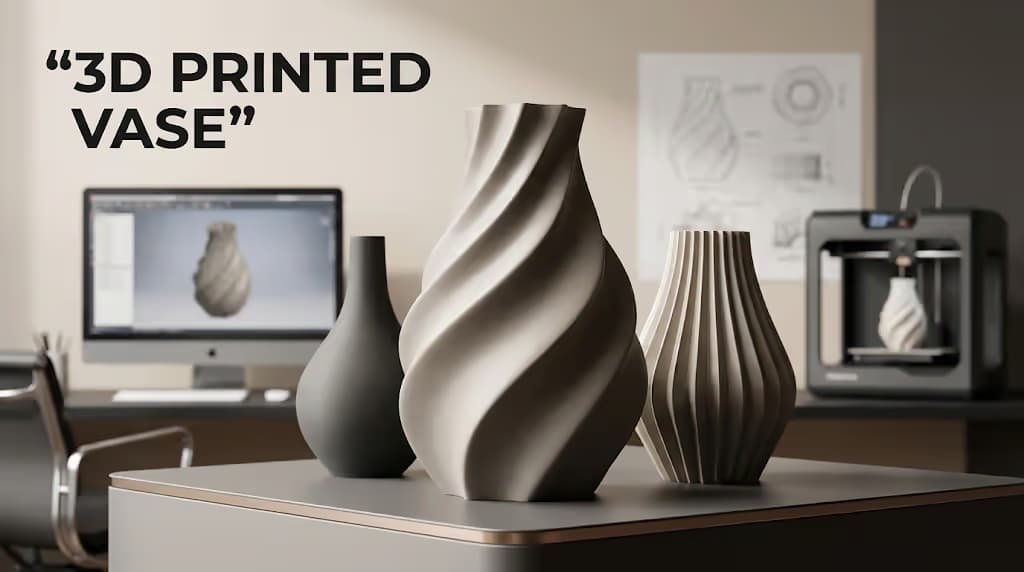
3D Printed Vase: Creative Designs Materials And CAD Modeling
3D Printed Vase: Creative Designs Materials And CAD Modeling
The 3D printed vase is an innovative solution by merging the decoration of product design with modern manufacturing technology. Whether it is for a beautiful vase with a spiral design, geometric patterns, organic curves, or modern home decoration – 3D printing allows you to experiment with designs that may be challenging to create with conventional techniques.
From designing a minimalist flower vase to making a sculptural centerpiece, or even a customised decorative object, the design process begins by knowing the shape, size, material, and purpose. Computer-aided design (CAD) is used to assist in the creation of a computer-generated model of the initial concept that can be assessed and made ready for production.
A 3D printed vase can also be used as an example of product development for product designers, makers, and businesses. It is used to test proportions, fine details on surfaces, and to test a design before progressing to a larger-scale production.
CAD design and prototyping are applicable to projects where precise geometric and dimensional considerations and manufacturing feasibility are critical and are considered relevant to CAD Verse Engineering. This guide covers some of the most common vase forms, materials used for making vases, modeling methods, printing considerations, and the importance of prototyping in developing unique decorative items.
What Is a 3D Printed Vase?
A 3D printed vase is a decorative or functional vessel created by adding layers of material together in a process similar to the way a 3D printer creates objects. The 3D printing process can generate numerous forms directly from prepped digital geometry, unlike conventional manufacturing, where a mold or special tooling is often required.
The designers can try out twisted surfaces, textured walls, curved profiles, geometric patterns, and unusual proportions. These features allow 3D printing to be beneficial for creating personalized decorative items and testing out design ideas.
The general workflow starts with a computer-aided design (CAD) or other 3D modeling software model. The model is sent in a suitable format, and then sliced into instructions for the printer using slicing software.
The final look and performance are dependent on the model, print technique, material, and machine settings. A decorative vase for dry flowers might have different requirements than a decorative vase for water.
Designers can make a good choice of geometry and manufacturing process if they grasp this distinction at an early stage.
Popular 3D Printed Vase Designs
One of the key benefits of 3D printing is that the design of the vase can be customized but the production process remains largely unchanged. Various design styles may produce unique visual effects and can be used for various decorative purposes.
- Vase Design — Main Characteristics — Design Considerations
- Spiral vase — Twisted surfaces and flowing lines — Curve continuity and wall geometry
- Geometric form (vase) — Angular forms, polygons — Edge definition and transition of surface
- Repeated ridges or grooves — Pattern spacing and consistent wall thickness
- Organic vase — Natural curves and irregular contours — Smooth transitions and printable overhangs
- Minimalist vase — Simplicity of design, clean lines and surfaces — Proportions and stability, finish
- Sculptural vase — Artistic forms and distinctive profiles — Print orientation, support and structural integrity
The right design will vary, depending upon the environment and the look you are trying to obtain. A simple, plain vase could work well in a contemporary setting, but a rustic or artwork-style vase can serve as a conversation starter on a table or shelf.
Shape, Height, and Texture Can Be Customized
Using CAD modeling, the height, opening diameter, base width, and outer profile of the vase can be controlled. Patterns can also be repeated, surface ribs can be added, or design twists can be used.
The difference between the final product and the finished product can be the difference between a small and a large adjustment. But decorative details must be compatible with the chosen printing method.
Very thin projections or deep undercuts, for instance, might need extra support or an alternative orientation. Examining these features in the digital model can minimize unnecessary printing issues.
CAD Modeling Is a Crucial Process In The Development Of A 3D Printed Vase
A computer-aided design allows one to create and evolve a design for a vase in a structured manner before production. It enables designers to precisely control geometry, to compare the various design options, and to determine if the design will satisfy the requirements.
1. Create the Initial Profile
It is often a two-dimensional outline, which represents the cross-section of the vase. By rotating this profile around an axis, it will form a symmetrical vase with a desirable shape.
Lofts, surface modeling, and meticulously created curves can create organic or sculptural shapes in more complex designs.
2. Create the 3-D Shape
Once the basic profile is defined, the designer may add other attributes like grooves, ribs, twists, or repeating surface patterns.
These features should be of a similar level of complexity to the printer that it will be used with. If the scale is large, it might fail to accurately reproduce all of the details.
3. Check Wall Thickness and Dimensions
The thickness of the wall determines the strength, weight, and appearance of the finished product. This is a value to be chosen depending on the material, the printing method, the geometry, and the intended use.
The base should also be sturdy enough to make sure that the vase doesn't tip over very easily. When designing a model that is to be fitted around an insert or other part, there must be adequate clearance.
4. Prepare the Model You Wish to Print
Review the geometry before exporting to see if there are gaps, intersecting surfaces, unsupported features, and other issues.
This model can then be exported to an appropriate file format and verified in the slicing software. By viewing the sliced preview, it helps ensure that the printer will make the walls, base, and surface features you want.
The Process Of Picking Materials For A 3D Printed Vase Is Quite Intricate
The choice of materials can have an impact on the look, longevity, and functionality of a 3D printed vase. The material to be used will determine the method of printing, as each material has specific printing requirements.
- Material — General Characteristics — Potential Applications
- Lead — Heavy metal, highly poisonous, found in batteries — Lead poisoning antidote, lead-based solders and paints
- PLA — Is commonly used for decorative prints and is offered in many colors — Display vases and prototypes
- PETG — Provides a balance of strength and flexibility — Decorative or functional designs were selected
- ABS — Can provide greater heat resistance than PLA in suitable applications — Designs requiring particular mechanical properties
- Photopolymer resin — Can be reproduced with compatible resin printers and produce fine detail — Small decorative models, detailed prototypes
These are only general comparisons, and not assurances of performance. There may be variations in results due to material formulations and printing conditions.
The Decorative Uses Are Not the Same as Holding Water
A vase to hold dried flowers or faux flowers will have different needs than one that will hold water.
Small gaps between printed lines can result in leakage for some 3D printed vessels. A seemingly watertight model can thus not always be relied upon to be watertight.
The design and manufacturing process has to be chosen if a vase is to contain water. It may be necessary to use a compatible insert or the vessel may need to be suitably sealed and leak tested. Make sure to check if the base is closed and that the print is suitably decorative before assuming it is watertight.
Some Important Points to Consider About 3D Printing
Once you get the digital model prepared correctly, you need to do something with it. Correct preparation of the digital model is just the first step. Printing conditions also impact the appearance and quality.
Print Orientation
The shape of the vase affects the texture of its surface, how it is supported, and how it is constructed. For tall narrow designs, may require attention to stability when printing.
Layer Height and Surface Finish
The height of the layers that are printed can influence how the printed texture looks. Smaller layers can enhance the look of curved surfaces but will take longer to print.
These ideal settings are dependent on the printer, material, and the geometry of the model for the desired finish.
Vase Mode
Some slicing applications have a mode known as "Vase" or "Spiralized outer contour". The technique allows printing of an "open-top" in the shape of a single rising wall instead of printing the walls separately.
It can be used in some decoration shapes, but not all vases. If the internal features, handles or geometry have breaks or interruptions in the continuous wall, a standard printing technique may be necessary. Always check the sliced preview before printing.
Assembly and Stability
Some designs are made up of several printed components. In such situations, dimensions and clearances need to be designed to ensure proper component assembly.
Also check the base and proportions to ensure that the piece will stand up in its desired spot.
CAD Verse Engineering Can Help With Product Development
CAD Verse Engineering can help with product development in a number of ways. A 3D printed vase shows a progression from a creative concept to an organized design process and prototyping. These processes are also applied in the development of new decorative products, consumer accessories, and other manufactured objects.
CAD Verse Engineering is dedicated to developing product design and engineering processes that facilitate the evolution of ideas into viable product designs. Depending on the requirements, this work can include CAD modeling, product development, prototyping, and design for manufacturing support.
Usually, a workflow will look something like this:
The exact process will vary depending on the complexity of the project and the manufacturing objectives. A simple decorative vase may not need as many iterations as a product with multiple parts or specific functional needs.
If your business is creating a new product, an early prototype can be used to validate the design before adding to the production efforts.
Frequently Asked Questions About 3D Printed Vases
1. Which Is the Best Material for a 3D Printed Vase? PLA is widely used in the manufacture of decorative pieces and prototypes. For specific needs, PETG and other materials might be better suited. The type to use is dependent on the intended use, printer, and material characteristics.
2. Can a 3D Printed Vase Hold Water? Not all printed vases are watertight. Water can seep around the minor spaces between the printed lines. If the vase will contain water, then an appropriate design, manufacturing process, and leak testing are necessary.
3. Which Software Do You Use to Create a 3D Printed Vase? Vase profiles can be created, dimensions can be changed, and decorative features can be developed using CAD and 3D modeling applications. The best software is a matter of the designer's skill and the complexity of the model.
4. What Is Vase Mode in 3D Printing? Vase mode is a slicing mode for printing some open shapes with a continuous wall. It can generate decorative forms with relatively little material that are smooth and compatible with the geometry only.
5. Is It Possible to Customize a 3D Printed Vase? Yes. It can be adapted by the designer with respect to height, width, profile, surface texture, opening, and decorative patterns. With CAD modeling, it is easier to create and tweak these options.
6. What's the Point of Using CAD Before Printing? CAD facilitates setting up the correct dimensions, checking geometry, and fine-tuning the design prior to manufacturing. It can also be used to detect potential problems which may otherwise require material or print time.
7. Do You Think the Prototype Will Help Improve the Vase Design? Yes. A physical prototype is used to test appearance, proportions, stability, and fit. These observations can then be used by the designer to improve the model and to generate further versions.
Conclusion
Printing a 3D printed vase is a creative approach to making a vase. Digital modeling enables designers to experiment with the most preferable shapes and decorative elements for a specific application and location, from spiral and ribbed surfaces to geometric or organic profiles.
There is more to a successful result than looks. CAD geometry, material selection, thickness, orientation, surface finish, and purpose all play a role in the product.
CAD modeling and prototyping can be used to test and refine original decorative designs for designers and businesses, adopting a structured approach to the process prior to production. For more information about product development and CAD modeling and prototyping support, check out the services provided by CAD Verse Engineering.
Need help applying this to your product?
Discuss Your Project