3D Printer Prototyping | Fast Product Development Services
3D Printer Prototyping | Fast Product Development Services
The process of developing a product is more than just creating a digital CAD model. Before investing in tools molds, large-scale manufacturing, firms must know how their product is going to appear, feel, and function in real life. 3D printing prototyping is a quick and efficient method of turning design concepts from digital to physical prototypes to test and improve.
From small-scale startups creating their first product, to established firms that refine an established design 3D printing is a great way to speed up production times and decrease the chance of costly production changes. If you follow the correct engineering method A prototype could help find design flaws early on and give valuable insight prior to production starting.
CAD Verse Engineering combines 3D printing, CAD design DFM prototyping, as well as manufacturing support. It helps the teams working on products move from idea towards production more confidently.
What Is 3D Printer Prototyping?
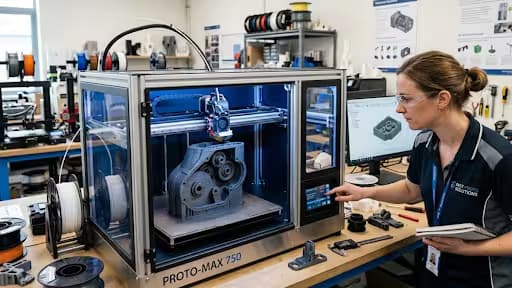
Prototyping with 3D printers is the procedure that creates a physical prototype directly from digital 3D model. Instead of creating costly molds, or using specialized tools engineers could utilize a 3D printer create a prototype one layer at a time.
This makes it much easier to evaluate different design ideas and dimensions, as well as evaluate components and develop different versions of an item.
A typical workflow begins with a CAD sketch. Engineers look over the model before preparing the required documents, choose a suitable material for printing, then print the first prototype. The printed part will be tested, inspected and then modified prior to the next design is printed.
It is particularly useful for products that require multiple stages of design and development.
Why Businesses Use 3D Printer Prototyping
Prototype development traditionally involves the use of tools, machining molds, tools, and long timeframes for production. When it comes to early-stage designs this method can result in experiments costly.
Through prototyping with 3D printers firms can experiment with concepts more effectively and make adjustments without having to commit to a large-scale production.
Benefits of key importance comprise:
- Faster prototype development
- Lower costs during early design stages
- Easy design modifications
- Functional and physical fitness testing
- Product iteration speed is faster.
- Lower manufacturing risk
- More effective communication between engineering teams as well as stakeholders
The physical model also provides teams the chance to spot difficulties that aren't apparent from the screen on a computer.
From CAD Model to Physical Prototype
The key to a successful prototype is an accurate design. CAD models allow engineers to determine dimensions, features, tolerances and other essential features prior to production.
In CAD Verse Engineering The creation process integrates CAD design and manufacturing with considerations. The process of discovery for the company comprises of design, simulation and prototyping and validation, which is then the handoff of production.
After the design has been finalized engineers will be able to select the right printing technique and the material that best suits the intended use of the prototype.
This process is integrated to make sure that the model isn't just a model for visuals, and is a valuable design tool to help develop products.
Choosing the Right 3D Printing Material
Material selection is a crucial element of 3D printing prototyping since different printers require distinct physical characteristics.
SLA Resin for Detailed Prototypes
SLA resin can be useful for prototypes that require high-quality details, smooth surfaces, and a precise visual representation. It is an excellent selection for precise product models or presentation prototypes. It is also a good choice for products where the appearance of components is crucial.
ABS for Functional Parts
ABS can be utilized in the case of a prototype that requires the most durability as well as practical toughness. It's ideal for testing in which the physical part needs to be able to handle greater hand-holding.
TPU for Flexible Components
TPU is a flexible and pliable material which can be beneficial to products that need elasticity, resistance to impacts and other components that are flexible. The choice of TPU lets engineers evaluate the performance of a design that is flexible before deciding to move on to manufacturing.
CAD Verse Engineering offers 3D printing with SLA resin, ABS and TPU, for a range of needs for prototypes.
How Prototyping Improves Product Development
- One of the main benefits to the 3D printing process is its ability to spot design issues prior to mass production.
- In this case, for example, a model could reveal that two parts aren't positioned correctly A button may be difficult to reach, or a housing is not clear enough or an element is in need of structural enhancement.
- In lieu of identifying these problems when expensive tools have been done, engineers could alter the design in CAD or print a second model.
- The iterative method helps the teams in the design process to move through several designs swiftly. Every prototype contains additional data which can be utilized to enhance the design of the following one.
3D Printer Prototyping and DFM
Prototyping is even more effective when it is combined in conjunction with Design for Manufacturing (DFM). The product might look great however it may cost a lot to produce at the scale needed.
DFM analysis examines designs from a manufacturing standpoint. Engineers can spot unnecessary complications, manufacturing issues that could be a problem as well as tolerance issues, along with possibilities for cost reduction.
CAD Verse Engineering provides DFM and CAD/CAM solutions, as well as prototyping and 3D printing services, aiding businesses to think about manufacturing needs before launching production.
This method can cut down on work and help make the transition between prototype and production easier.
Who Can Benefit From 3D Printer Prototyping?
3-D printer prototypes is a boon to a broad array of industries and designers, for example:
- Startups are developing products for new startups
- Inventors testing product concepts
- Companies that sell consumer products
- Industries equipment producers
- Automotive component developers
- Electronics-related businesses
- Robotics companies
- Teams of mechanical engineers
- Product designers
- Established companies that improve existing products
It doesn't matter if the aim is to test a basic enclosure or check an intricate mechanical device prototyping in a short time can offer valuable information prior to production.
Why Choose CAD Verse Engineering?
The choice of a trusted engineering partner will assist in prototyping the process to be easier. CAD Verse Engineering provides an seamless path from conception and design to DFM and 3D printing testing of prototypes, as well as production assistance.
The firm works with entrepreneurs or inventors as well as established companies across the globe and provides the ability to turn around prototypes in 24 to 72 hours, based on the scope of work.
Instead of focusing on prototyping as a separate service, CAD Verse Engineering connects tangible prototypes to practical manufacturing and engineering choices.
Move From Prototype to Production
Prototypes are most useful as it helps in the subsequent step in the process of developing a product. Following testing and refinement The finalized design may be made ready for production using the correct tolerances manufacturing files, tolerances, and requirements for quality.
CAD Verse Engineering supports this change with its manufacturing and production assistance, assisting teams to move from prototyping validation to scaleable manufacturing.
Get Started With 3D Printer Prototyping
If you've got a product idea, CAD sketch or an existing design that requires physical validation prototyping with 3D printers could help verify your idea before you make an investment in manufacturing.
From precise SLA prototypes, to sturdy ABS components and flexible TPU parts choosing the best printer will depend on your specific product needs and goals for validation.
CAD Verse Engineering can help turn your concept idea into a physical model and assist you in the steps to take towards manufacturing. Send us your concept for the product or CAD design files, and get an expert's opinion on manufacturing or prototype strategies, as well as the most effective route to producing a product.
Need help applying this to your product?
Discuss Your Project