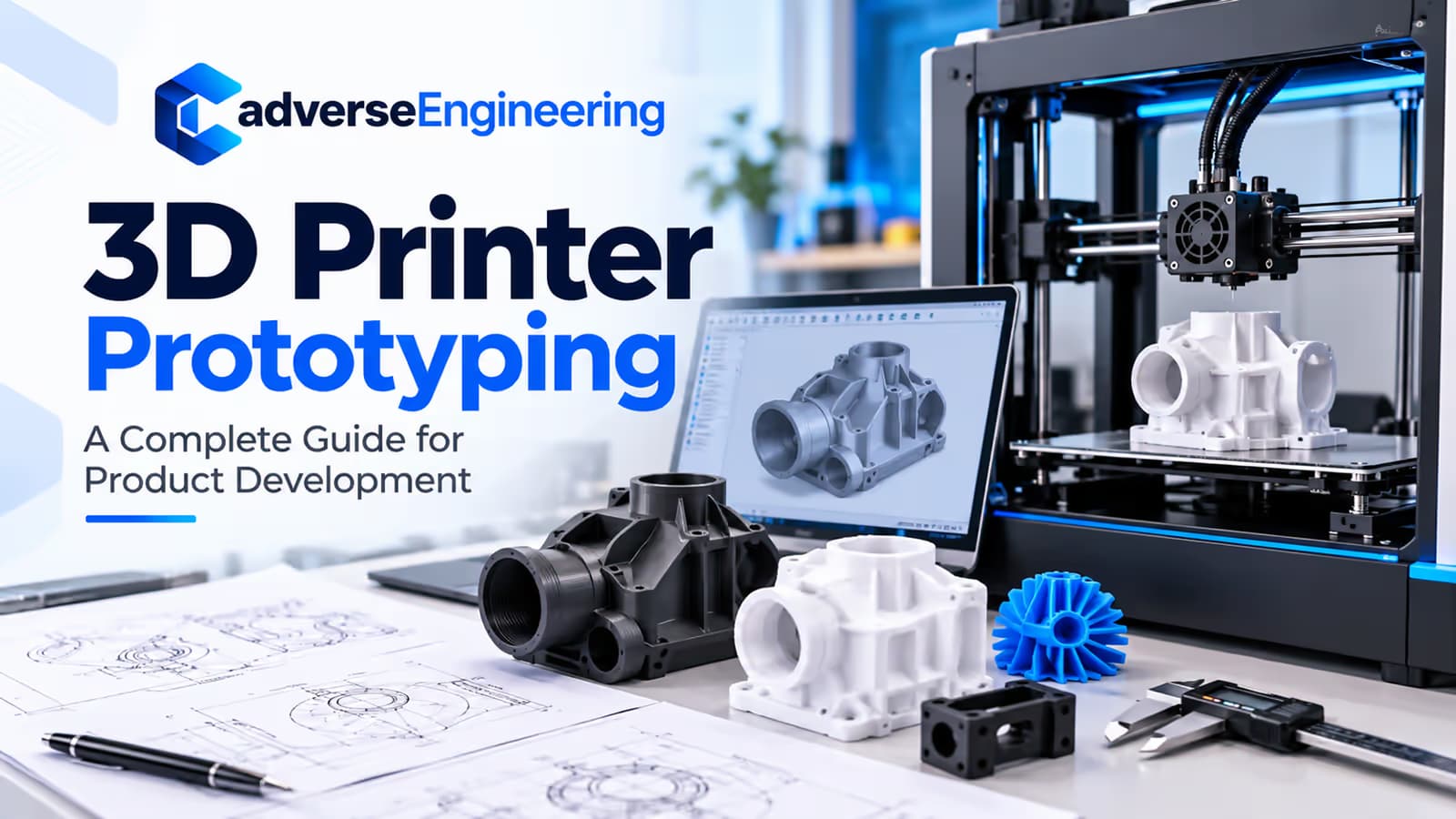
3D Printer Prototyping Services for Product Development
3D Printer Prototyping Services for Product Development
When developing a product, it is important to plan, design, and test the product prior to production to make sure that it is successful. A 3D printer can be used to make a prototype of the product design, so it is possible for companies to make a physical model of the design to inspect, test, and improve the design before the product is produced. From new product development by startups to component optimization by established manufacturers, 3D printing offers a flexible solution for product development.
Engineers can make use of physical models to identify design issues and modify their designs as a result. Businesses can benefit from CAD design and prototyping services, as they can enhance their development processes and make better decisions regarding their investments in manufacturing.
What Is 3D Printer Prototyping?
3D printer prototyping is the design of a 3D prototype using 3D printing technology. A 3D printer produces a 3D object from a computer-aided design (CAD) model.
Typically begins with a computer-generated design of the product. The model is programmed by engineers for printing, then a material is selected, and the printer is set up according to the specifications of the project. The prototype can then be reviewed post-print to ensure the right size, shape, and look, and the correct functional features for assembly.
This is particularly useful when there are several design cycles for the product. A physical prototype can then be used to preview how the production can be enhanced before proceeding with (more expensive) production methods and techniques, which can then be refined in the digital design.
There are many benefits to 3D printer prototyping. There are numerous advantages to 3D printer prototyping.
Benefits Of 3D Printer Prototyping
Faster Product Development
Traditional manufacturing processes may require special tooling and extensive preparation work before manufacturing a physical part. 3D printing can make parts easier to develop by creating parts from digital designs.
Engineers can look at prototypes, take input, and make new prototypes without the need to rebuild traditional tooling for every change. The actual turnaround times vary based on the complexity of the component, the printing technologies, and finishing needs.
Reduced Development Costs
In the initial product development phases, 3D printing will save time and money from having to create expensive tooling. A prototype will be tested in order to evaluate a business before the company invests time or money in moulds, production machinery, or any other manufacturing devices.
The quantity of savings will depend on the project and production volumes, but production problems that occur early in the design process can be avoided and prevent the need for additional manufacturing costs.
Improved Design Validation
Although a digital model would give information about the product geometry, engineers can take a look at the actual product by creating a physical prototype. They are able to measure dimensions, check assembly relationships, and determine potential problems that may not be obvious on a screen.
Flexible Design Improvements
Product development is a process of continuous changes and iterations. With 3D printer prototyping, engineers can make a change to a CAD model, print a new version, and then re-evaluate.
This flexibility allows companies to modify product sizes, forms, and assembly throughout product development.
Commonly Used 3D Printing Technologies for Prototyping
The choice of the correct printing technology is a key factor, as different technologies offer a different surface finish, strength, material compatibility, and detail.
FDM 3D Printing
Fused Deposition Modeling (FDM) is a technique that builds parts in layers of thermoplastic. It's commonly used for concept modelling, brackets, housings/fixings, and some functional prototypes.
From a simple product geometry perspective, FDM might be a good option for testing products, but the quality of surface finish and dimensional accuracy will vary for different printers, materials, and settings.
SLA Resin Printing
Stereolithography (SLA) is a process used to three-dimensional print a liquid photopolymer resin using light. The technology is frequently used with detailed models, which need fine features and a smooth surface finish.
It can be useful and effective in visual prototypes, complex product designs, and components where aesthetics is an important consideration.
SLS 3D Printing
Selective laser sintering (SLS) is one of the ways to produce a solid object from powdered material. It produces complex geometries and can be used to produce some functional prototypes.
The optimal technology will be determined by the application of the product, design requirements, materials, and budget.
Materials Used in 3D Printer Prototyping
The materials selected will impact the strength, flexibility, look, and testability of a prototype.
Common materials include:
- PLA: Simple concept modelling and visual prototype.
- ABS: Good for some durable prototypes and parts.
- TPU: If flexibility and elastic properties are required.
- Photopolymer resin: If detailed models are desired, use a photopolymer resin that will provide features and smoothness if desired.
The materials are not the same and do not have the same properties or limitations. For example, the resin sample used for visual inspection might not be capable of withstanding mechanical stress similar to an engineering material component.
Thus, the type of materials chosen should be based on the purpose of the prototype, the operating conditions, and the testing requirements.
The 3D Printer Prototyping Process
Even though it is a long process, a structured workflow can facilitate businesses in creating prototypes that are in line with the product needs.
Identify the Requirements of the Product
Identify the requirements of the product. Identify the required.
Figure out the job of the product, its dimensions, the materials it needs, and testing that must be carried out. The design and printing method are determined by clear specifications.
Develop the CAD Model
- The next step is to develop the CAD Model. It's time to develop the CAD Model.
- Design or modify a computer model using CAD.
- The drawing should be based on a correct geometry, dimension and relationships amongst the components.
Prepare the File for Printing
- To print, the file needs to be set up. The file must be set up for printing.
- Analyze the model and determine if it is printable, how thick it is, and the orientation and support it will require.
- Assemble the file in a way you want to see it printed.
Print the Prototype
- To print the Prototype, click the icon below. To print the prototype, click on the icon below.
- Design and make the physical component using selected technology and material.
- Printing time is dependent upon the size, complexity, resolution, and printer settings for the part.
Check and Improve the Prototype
- It's time to check and improve.
- Time to review and hone.
- Test the printed prototype against the requirements.
- Revise the CAD if needed and make another version for additional analysis.
Applications of 3D Printer Prototyping
A 3D Printer Prototype is used in a variety of applications. There are several uses of a 3D Printer Prototype. Product development is supported with the use of 3D printer prototyping in the following industries:
Consumer Products
Businesses can test product housings, accessories, enclosures, and everyday product concepts prior to production.
Automotive Engineering
Prototypes can be used to test the geometry of parts, their mounting features, interior parts, and assembly features.
Industrial Equipment
Engineers can develop models for brackets, fixtures, housings, and other special mechanical components.
Electronics
Printed enclosures enable the placement of components, dimensions, access points, and assembly needs to be determined.
Product Development For Startups
Product developers: Physical prototypes can assist in presenting an idea, collecting input, and refining the product design prior to investing in a large-scale production. The appropriateness of a prototype is dependent upon the application. Additional engineering studies, material validation, and testing may be required for materials used in critical or challenging applications.
Why Choose CAD Verse Engineering for 3D Printer Prototyping?
CAD Verse Engineering offers CAD design, 3D printing, prototyping, and design for manufacturing services to help in product development. These services enable businesses to move from the concept of digital models to physical models where they can be reviewed and improved.
If you already have a product concept, a technical drawing or CAD design, you'll need to decide on the type of prototype that is most suitable for your design needs, budget and end product.
Accurate CAD modeling paired with real-world prototype testing can help to determine what could be improved prior to manufacture. The businesses will then be able to use these insights to make further adjustments to their design and progress forward in the development process.
Frequently Asked Questions
How Long Will 3D Printer Prototyping Take? This can depend on the complexity of the model, its size, material, and what the printer and finisher can produce. The prototype can be completed within one hour if not complicated, or take a few days or even a few design changes.
Will Functional Prototypes Be Possible with 3D Printing? Yes. Prototypes can be used to test dimensions, parts fit, assembly, and selected mechanical properties depending on the technology/material used. A printed prototype is not to be used as an equivalent to a manufactured part, however.
What Is the Material or File Format That You Require to 3D Print? STL and 3MF are the most common file formats. STEP files are also commonly used to share CAD information and to make further engineering changes.
Can a Prototype Be Directly Rolled Out for Mass Production? Not always. More engineering reviews, material validation, manufacturing changes, and testing might be needed before manufacturing. The steps required will vary according to the product and how it is to be used.
Conclusion
By using a 3D printer in prototyping, it allows the companies to obtain a physical copy of the product concept and test for design changes and modifications prior to it going into production. By using the proper CAD design, printing technology, and materials, companies can better select their product development.
CAD Verse Engineering provides help in CAD design, prototyping, and manufacturing preparation support for businesses to create and perfect product ideas. Discuss what you need in your project with the team and brainstorm a possible solution to your next product development project.
Need help applying this to your product?
Discuss Your Project