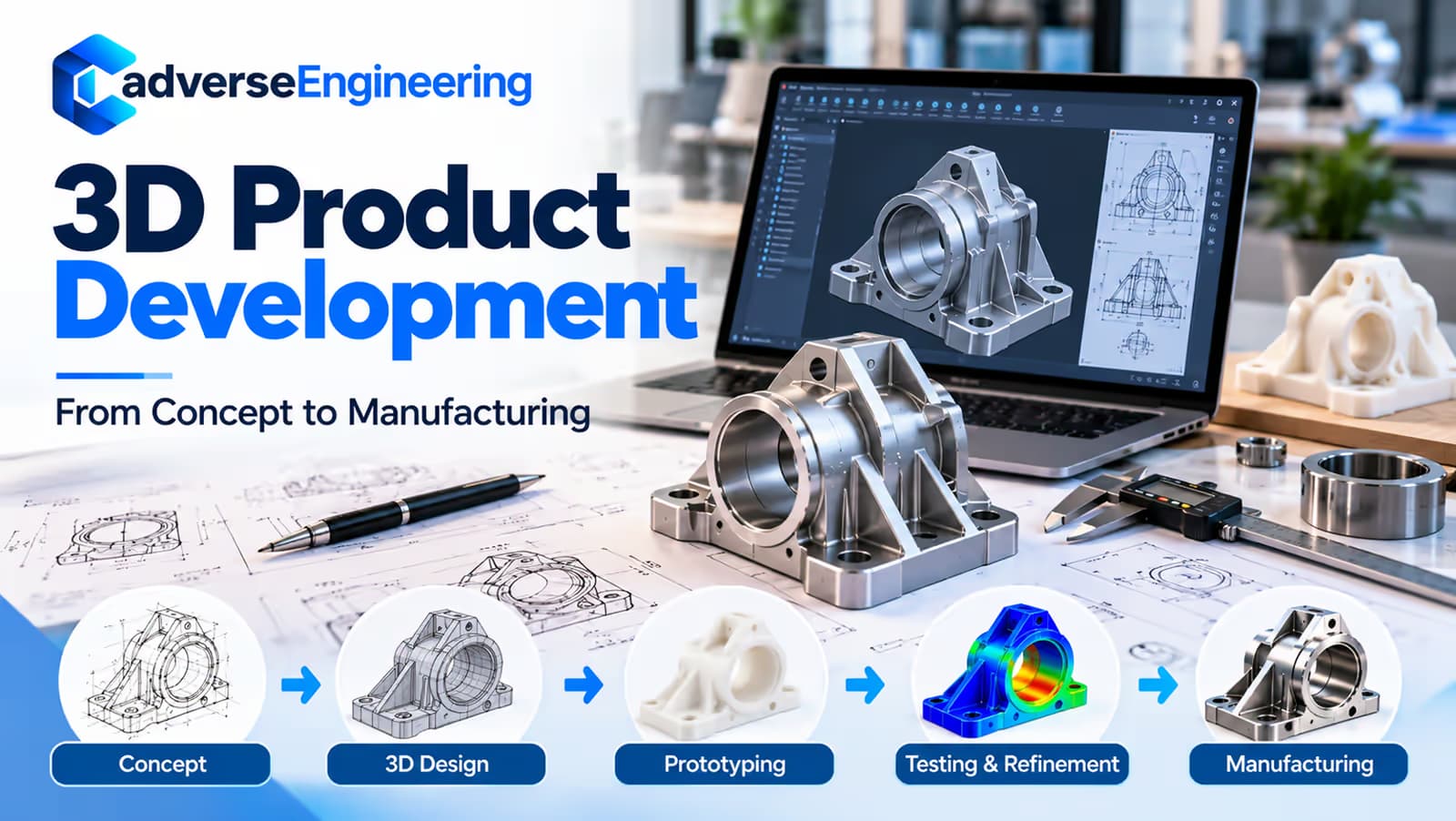
3D Product Development: From Concept to Manufacturing
3D Product Development: From Concept to Manufacturing
Building a successful product is no simple task, and it cannot be done solely with a creative idea. But businesses must be able to draw precise designs, have working prototypes, and know how the implementation will proceed to make the concept ready for the market. The product development process can be applied to convert an idea into a virtual 3D model that can be reviewed, tested, and improved, and is ready for manufacture.
In fact, the 3D design technology can help engineers visualize a product even before it comes to life – whether it's a consumer product or an industrial piece of equipment. This can assist in the identification of design problems at an early stage, increase accuracy, and minimise needless revision.
What Is 3D Product Development?
The design and development of a three-dimensional product created and improved prior to the making of the product is 3D Product Development. It can be included in Product Design, CAD (Computer-Aided Design), Prototyping, and Design Optimization.
A 3D model is a more comprehensive model of a product from a number of different angles, unlike a basic sketch. Designers can check it out before they enter the production process, considering its size, shape, characteristics, and structure.
Common services include:
- A 3D experience of CAD modeling and product design.
- Creating mechanical devices and systems.
- Technical drawings and product visualisation.
- Making a prototype and improving it is important!
- Manufacturing preparation.
Why Is It Important That a 3D Product Is Created?
Better Product Visualization
With 3D Models, businesses can get a glimpse of a product before it is made. Its shape, size, and characteristics can be looked at by designers and are more easily communicated to designers for the purpose of changing or improving.
Reduced Design Errors
Using digital models, engineers can check the dimensions, placement of components, and the relationship between these components. It is important to recognise potential problems at the design phase so as to minimise costly changes later.
Improved Prototyping
A 3D product development base is used to make prototypes. Depending on the design requirements, models can be designed to include 3D printing and/or CNC machining or other prototyping processes.
A More Efficient Design Process
Digital models can be changed, as opposed to traditional models, which require going back to the start of the product to make changes. The flexibility enables teams to think about different concepts and effectively manage design changes.
Types of 3D Product Development Services
There are two kinds of 3D Product Development Services.
A variety of design strategies are needed for various products. Services needed are dependent on the complexity of the product, its use, and manufacturing requirements.
- Service — Purpose — Applications
- 3D CAD Modeling — Creates detailed 3D CAD models — Product parts and equipment
- Product Design — Product shape and features — Consumer products and accessories
- Mechanical Design — Designs mechanical parts and assemblies — Machinery and industrial equipment
- 3D Product Rendering — Creates realistic product images — Presentations and marketing
- Prototype Development — Proposes prototypes — Develops designs for physical testing
- Technical Drawing — Describes dimensions and specifications — Manufacturing and fabrication
The 3D Product Development Process
1. Concept Development
The first step is to comprehend the concept of the product, how the product will be utilised, and the size and operation of the product. Sketches, reference images, and project specifications are incorporated into the design, which is clear in direction.
2. 3D CAD Modeling
The designer takes advantage of suitable CAD software to design a 3D digital model. The model may be one part, a complex surface, or a whole assembly as per the project.
3. Design Review and Design Refinement
The model is checked for dimensions, clearances, component fitting, etc., and design requirements. Changes are made as required before the start of the prototype and/or production process.
4. Prototyping and Testing
Judging the look, size, and use of a product can be done by using a physical model. It can be manufactured by 3D printing, CNC machining, or other appropriate means depending on the project.
5. Manufacturing Preparation
Revisions to designs can be carried out, and then final deliverables can be made. This can include CAD, Technical drawings, and assembly models needed by the manufacturing team.
Industries That Use 3D Product Development
This is a list of examples of manufacturing sectors that are dependent on 3D Product Development.
3D product development can be used in a number of industries.
- Consumer Products: Design of household products, accessories, electronics enclosures, and everyday products.
- Mechanical Design: Designs brackets, housings, mechanical components, and assemblies in an automotive context.
- Industrial Manufacturing: Assists in the manufacture of machine components, parts, and production fixtures.
- Engineering: Provides components that are required as part of the project design.
- Electronics: Assists in the design of enclosures, mounting parts, and product enclosures.
Benefits of Professional 3D Product Development
Professional 3D product development has numerous benefits. Businesses can benefit from collaborating with an experienced design team to ensure they are able to meet the technical needs and get their products ready for production.
Key benefits include:
- Design accuracy: Detailed models can be used to check dimensions and coordinate the design.
- Understanding product ideas: Visual models help communicate ideas of products.
- Early problem identification: A design review could help to find issues before manufacturing.
- Easy changes: The digital designs can be amended to reflect the changes in the requirements.
- Manufacturing support: CAD drawings and technical drawings help to communicate design requirements.
The actual cost, time, and results achieved will depend on the material, manufacturing processes, complexity of the product, and testing requirements.
How To Choose A 3D Product Development Company
When choosing a service provider, check their experience, CAD, communication, and manufacturing knowledge.
Inquire about past assignments, acceptable formats, revision policies, what is expected, and the expected timeframe. It is important that everyone involved in a project has a clear understanding of what is required in the project through a clear project scope before a project starts.
Choosing a provider with experience in product design and manufacturing can facilitate the development process.
3D Product Development Services at CADVerse Engineering
CADVerse Engineering can convert product concepts into detailed product designs, providing CAD modeling and engineering design support services.
A good modeling technique can help get your project started when creating a new product, working on an existing part, or planning to prototype a new design.
The design of every project should begin with an idea and advance to detailed 3D models, with the designed functions, designed goals, and manufacturing process all taken into account.
Frequently Asked Questions
What Is 3D Product Development Used For? The goal of 3D product development is to create real-life products. Digital product modelling, design checking, and preparing prototype production and manufacture.
What Is the Difference Between 3D CAD Modeling and 3D Product Development? Product development can include concept planning, design development, prototyping and manufacturing preparation, whereas the emphasis of 3D CAD modelling is on the development of a digital representation.
Can 3D Product Development Help to Reduce Cost? It may be useful in finding design problems early on and reducing needless alterations in the design. Project/Production specific savings are being realised.
What Kind of Files Are Allowed to Be Sent? Depending on the project, I can provide you with CAD files, STEP files, technical drawings, assembly models, product renderings, and more.
Conclusion
By utilizing the 3D product development, businesses can convert ideas into particular designs, and these can be analyzed, refined and ready for manufacturing. By creating CAD models, prototypes, and technical documentation, businesses can make informed decisions before going into production.
CADVerse Engineering offers CAD and product design solutions to help companies from concept to engineering solutions.
Need help applying this to your product?
Discuss Your Project