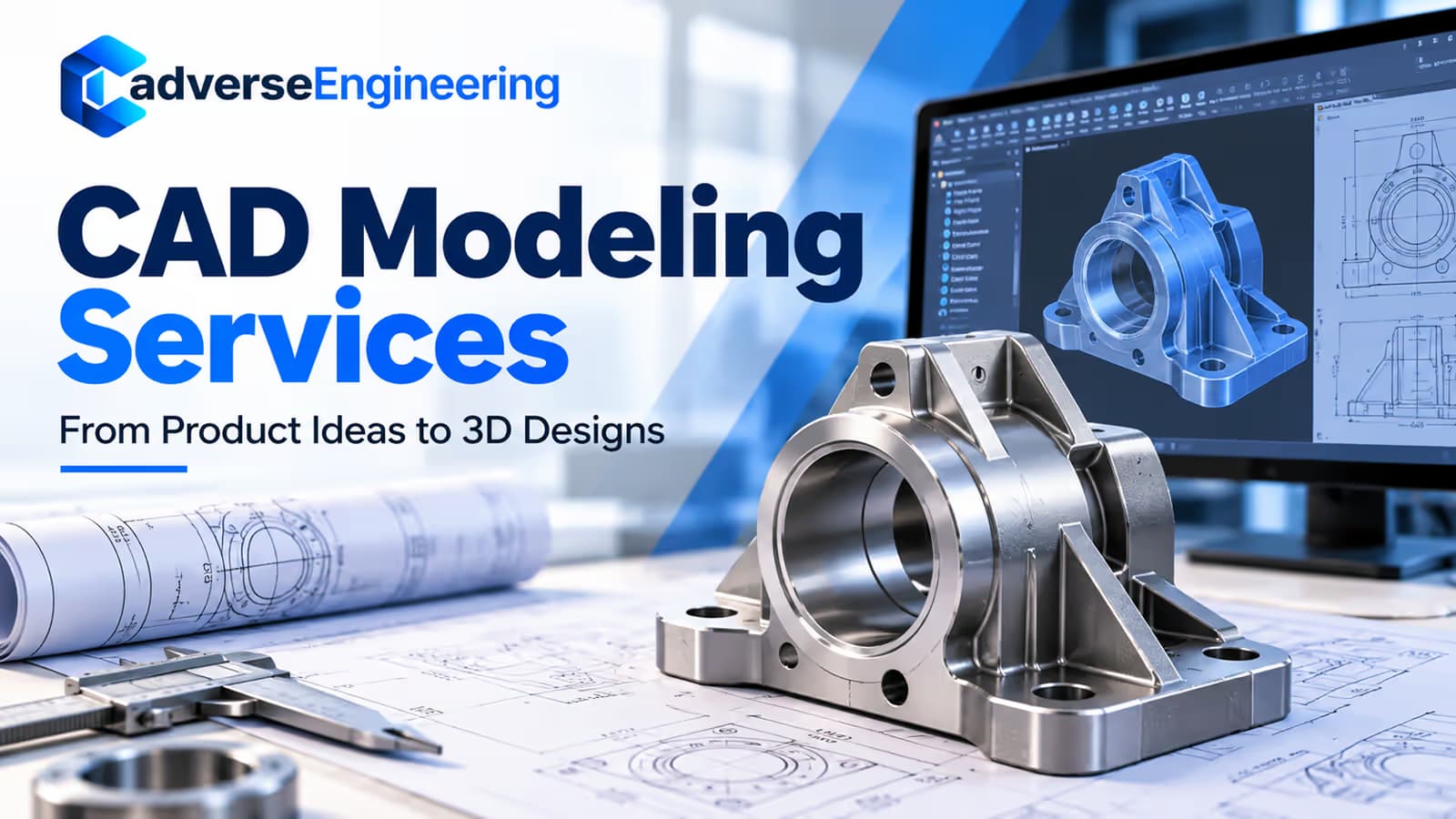
CAD Modeling Services: Turning An Idea Into A 3D Design
CAD Modeling Services: Turning An Idea Into A 3D Design
CAD Modeling Services is a thrilling experience, turning an idea into a 3D Design. CAD Modeling Services is a thrilling process that starts with an idea and progresses to a 3D Design.
Concept to design involves careful planning, measuring, and selecting engineering tools. It is desirable to have a detailed 3D design of a product, whether it be a consumer product, an industrial part, or a mechanical assembly, for CAD modeling. Companies may either use expert CAD modelling services to create concepts or create prototypes and manufacture them.
Having a detailed CAD (Computer-Aided Design) model for start-ups, inventors, engineers, and manufacturers can be very useful to visualize, evaluate, and improve their designs before they actually come to life. Close cooperation with an experienced engineering team will also help to streamline design changes and prepare the engineering drawings for the different manufacturing processes.
What Are CAD Modeling Services?
CAD modeling services are services offered by computer-aided design software that creates a virtual model of products, components, mechanical assemblies, and other items. These models can be used to describe the form, size, structure, and other significant elements of any object design.
CAD modeling can be 2-D technical drawings, 3-D parts, assemblies, or detailed product designs, depending on the project. The models can be used by engineers in the creation of design communications, exploring component interactions, and technical documentation.
No business can afford to build a physical prototype of a product if they want to make changes to the design before the product is made, and that is why it is crucial that they create a CAD model of the product during the product development phase.
Types of CAD Modeling Services
There are a variety of types of projects, and each of these will need different modeling techniques. The level of service that will be needed will depend on the complexity of the product, design, and how the product will be manufactured.
1. 3D CAD Modeling
3D CAD modeling software creates 3D shapes and models and allows the engineer to see the shape, size, and construction of the product from different angles.
Helpful in the development of products, mechanical components, industrial equipment, consumer products, and planning for prototypes. A detailed 3D model can also help the team to discuss the design requirements.
2. Mechanical CAD Modeling
Mechanical CAD modeling is the engineering of parts, machines, equipment, and mechanical assemblies. Engineers create models of objects and how objects are connected to particular parts of an object.
Create machine parts, brackets, housings, enclosures, and other engineered parts using this service. Hence, the dimensions and clearances play a vital role in making models in practical applications.
3. Product Design & Modeling
Product design and modelling enables a concept to be built up to a detailed digital design at an early stage. This could be product geometry, dimension optimisation, component layout development, and the development of 3D designs for prototypes.
These services are beneficial to start-up companies to find out if a product concept is viable or to an established business to discuss design specifications prior to production.
4. 2D Technical Drawings
Technical drawings in 2D are used to communicate valuable information about the dimensions, form, and production specifications of a component.
Drawings can contain a view of the part, tolerances, annotations, and measurements depending on the project. These documents are utilized to help the engineering, manufacturing and production team to understand how a component is to be made.
5. Assembly Modeling
Assembly modeling is the process of combining various components of a design into a single assembly. Helps engineers to understand the interactions between individual components and potential positioning, spacing or component relationship issues.
Assembly models are useful for products that are made up of multiple mechanical components or interdependent components.
Benefits of Professional CAD Modeling Services
There are several benefits of hiring professional CAD modeling services. Professional CAD Modeling Services have numerous advantages.
A professional CAD modeling service is a great asset to have. There are advantages to a professional CAD modeling service. Using CAD modeling can offer multiple benefits in the process of product development.
Improved Design Accuracy
Digital models enable engineers to communicate the dimensions and geometry more precisely than just with an informal sketch. Communication between the design and manufacturing domains is difficult, and if the design information can be shared, it can be beneficial to reduce misunderstandings and reach a consensus.
Easier Design Modifications
The features of the product can be modified during the development process. Engineers can make changes to dimensions, features, and experiment with different design possibilities without ever having to make a physical prototype again with CAD models.
These changes can be incorporated as a way to decide beforehand what option(s) are most suitable for picking a final design.
Better Product Visualization
For better understanding of how a product looks and how it is constructed, a 3-D model is useful. All design, engineering, client, and manufacturing participants can view the same digital models and discuss and share ideas on how to make improvements.
Support for Prototyping
CAD models can be used to base on prototype development. Depending on the design, a model for a process such as 3D printing or any other manufacturing process might need to be prepared following the file specifications.
Digital review is a crucial tool to test a physical prototype and discover problems that may be hard to identify in the digital process.
Becoming More Organized in Manufacturing Preparation
Preparing a CAD file and/or technical drawing can help with the communication of manufacturing requirements. They serve as a reference to dimensions, shape of the components, and other design data to be used in the process of production planning.
But a CAD model is not enough to ensure manufacturability. Other factors such as material selection, tolerances, production techniques, and engineering validation may need to be done as well.
Industries That Use CAD Modeling
CAD modeling is used in a variety of industries. CAD modeling is utilized in different industries. In different industries, the requirement to capture the product accurately for modeling and technical documentation has been met through the use of CAD modeling.
Manufacturing and Industrial Equipment
Machine parts, equipment housings, fixtures, and mechanical parts are designed using CAD models.
Consumer Products
Product developers can utilize digital models to refine the design of everyday (product) items, accessories, enclosures, and household goods.
Automotive Engineering
CAD modeling is used in the automotive industry for the engineering and design of vehicle components, brackets, car interior components, and other vehicle-based products.
Electronics
Engineers can model product enclosures, mounting features, and structural components that fit electronic assemblies.
Medical Product Development
The design of selected parts or housings of medical products is carried out using CAD models, based on the requirements of engineering, safety, and regulations.
Startups and Inventors
CAD modeling is a wonderful resource for inventors and startups because they can visualize their concepts and create a virtual model that can be assessed, prototyped, and shared with manufacturing partners.
The CAD Modeling Process
The CAD Modeling Process is performed in the following manner:
There are several steps that are involved in a CAD modeling process, but the exact process will depend on the project.
Step 1: Define the Project Requirements
Make a list of what needs to be done for the project. List the requirements for the project. Outline project objectives and needs. Define the project needs and scope of the project.
This first step involves understanding the product concept, its use, its size, functionality, and reference materials. Sketching, photographs, and drawings that already exist can be sent to the client to be scaled.
Step 2: Create the Initial Model
Sketch a preliminary sketch of the first model. Sketch the original model. The first model will be created in step 2. The second step is to develop the first model.
The designer uses the information given and creates the first CAD model. This stage is where the basic design of the product or component is established, and the overall geometry of the product is established.
Step 3: Review and Refine the Design
After finishing the drawing, look at and refine the plan. Once you have finished the sketch, check it over and make corrections.
- Look at the design and make alterations if necessary. Reconsider and modify the design, if necessary.
- The requirements of the project are checked with the model. This could lead to changes in dimensions, shape, positioning of components or other design elements.
- Client feedback can be used to guide revisions and to further tweak the design to achieve the desired result.
Step 4: Create Technical Files
- Create Technical Files.
- Create technical files.
After creating a design review, the necessary drawings and files can be created. Deliverables are what the project needs and can consist of: Editable CAD models, neutral-format 3D models, and/or 2D technical drawings.
These are generally in STEP, IGES, STL, or native software as per manufacturing requirements and tools.
Step 5: Provide Support for Prototyping and Manufacturing
- Provide support for prototyping and/or manufacturing.
- Support the prototyping or manufacturing. Assist with prototyping or production.
Once the design is complete, it can be incorporated into a prototype product, or discussed with the manufacturer or engineer. Further analysis and/or design modifications may be necessary before manufacture.
How to Choose the Right CAD Modeling Company
Choosing CAD modelling firms can be a difficult task. Picking the ideal CAD modeling company can be a challenging process.
However, the choice of the provider is not limited to price, and you need to consider other factors. These should be taken into consideration: Engineering knowledge, Communication process and project needs of the provider.
Identify the complexity of designs and the quality of designs in previous samples of work and compare and contrast them with these. Ask questions about software and types of files used, the length of the projects; the revision process; and ownership of the final products.
It's also a good option to discuss the need for CAD modeling, or add other services like product design, prototyping, engineering analysis, and manufacturing support to this project.
By setting from the beginning the clear objectives and expectations of the project, miscommunication and project chaos can be minimized.
CAD Modeling Services at CAD Verse Engineering
CAD Verse Engineering provides CAD modelling services for the industry. CAD Verse Engineering offers CAD modeling solutions to the industry.
CAD Verse Engineering offers engineering and design services to support product development. Evaluate the company's services to understand which of them suit your project needs if you are searching for CAD modeling help.
Whether you are looking to augment an existing product or develop a brand new product concept, you must be fully aware of your product's requirements, dimensions, functions, deliverables, and manufacturing goals to ensure your project takes off from the launching pad.
Contact the team on the official website and discuss your project needs and the subsequent stages.
Conclusion
With CAD modeling services, businesses can transform product ideas into comprehensive digital designs, which can facilitate product reviews, enhancements, prototyping, and manufacturing preparation. Depending on the project, 3D CAD modeling and mechanical assembly, technical drawing, or product development may require the appropriate approach.
Organizations can enhance the communication of design requirements and ensure their products are ready for the next stage in development by clearly stating the requirements and working with an experienced engineering provider. Carefully search out the provider's experience and know what they can do for you and what they will give you before selecting a provider.
Frequently Asked Questions
1. What Is CAD (Computer-Aided Design) Modeling Services Used For? CAD Modeling Services create digital images of products, parts, and assemblies. The Models are used for Design Development, Visualization, technical documentation, and manufacturing preparation.
2. What Is the Difference Between 2D CAD vs 3D CAD Modeling? 2D CAD modelling is 2D drawings with geometry and dimensions. 3D CAD modeling produces three-dimensional models which will show the shape and structure of the object from various angles.
3. So, Who Needs CAD Modelling? CAD modeling is utilized in a wide variety of design and development activities, including automotive design, electronics, consumer products, industrial equipment, and other engineering-related industries within manufacturing.
4. Is It Possible to 3D Print a CAD Model? Yes. If the geometry and file type are proper for the printing process, there are many CAD models that can be printed. Adjustments may be necessary for some models before printing.
5. What Are Some of the Standard Files You'll Encounter in CAD Modeling Projects? This can involve providing native CAD files, STEP or IGES files, STL files, and 2D technical drawings. The format selected will vary based on the needs of the project and how it will be used.
6. What Is the Price of CAD Modeling Services? The price for the job will be based on the complexity of the design, number of components, level of detail, changes to the job, and the product that will be delivered. After the provider has viewed the project requirements, he/she is in a better position to provide an accurate estimate.
7. What Is the First Thing in a CAD Modeling Project? Make sketches, drawings, photographs, measurements, and project specifications as necessary. Provide this data to a CAD modeling company with which you wish to discuss the scope of work, timeline, and milestones to be delivered.
Need help applying this to your product?
Discuss Your Project