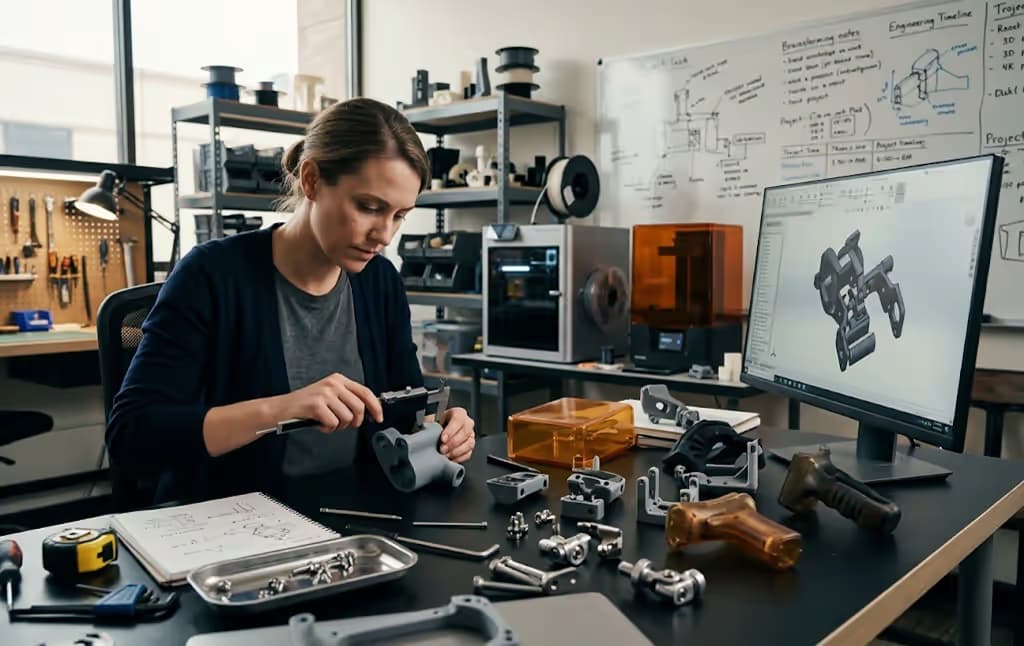
CAD Prototyping: Build Better Products BEFORE Manufacturing
CAD Prototyping: Build Better Products BEFORE Manufacturing
In digitized computer-generated drawings, a product may look great, even though it turns out to cause problems when it's a real product. One component can be hard to assemble, a housing might not give enough clearance, or two parts may interact with each other when they're manufactured. CAD prototyping can be used to gain hands-on experience with these issues before they settle into being costly manufacturing issues.
Use of computer-aided design in conjunction with physical prototype development allows the engineers to view how the product moves from a digital model to a realistic product physical. It can be utilized for mechanical parts, consumer products, industrial equipment, enclosures, assemblies, and many other engineered products.
The Role Of CAD Prototyping In Engineering
CAD prototyping is most useful when the prototype is linked to the engineering model involved. The engineers can develop the prototype directly from a defined CAD design, instead of providing a physical sample and treating the information in that sample a basis for documentation.
This is a great relationship for example between a Digital and the Physical Product.
In cases of a change the CAD model can now be changed and then another prototype can be used from the updated design. This will create easier flow in the development process, particularly if a product experiences multiple design changes.
A Prototype Can Reveal More Than A CAD Screen
An engineer might have a prototype that he can hold in hand, put together the various parts, look at the proportions, verify any interfaces, etc. and assess how the various parts of the prototype interact. In addition, the physical model can give feedback to the person/people using the product with regard to size, grip, ease of access and ease of use for products that are intended for human use.
- This is important especially for products whose size has an impact on their functionality or experience.
- Mechanical assemblies: prototype can be used to test the fit of the components of the assembly as well as whether or not the intended sequence of the assembly is viable.
Convert An CAD-Model Into A Prototype
- The work process starts with an appropriate CAD model. The design should include the appropriate geometry and dimensions for the product being designed.
- The model can then be ready for the desired prototyping technology. The prototype can be fabricated or developed using an appropriate 3D Printing or 3D Fabrication technique if required.
- Without the physical model, it is impossible to check whether the design requirements have been fulfilled or not. This can then be used to modify the CAD in any required way.
- This renders the CAD model an active engineering resource, instead of a static drawing.
Different Prototype Goals And Approaches
There are several different approaches that will use different Prototype Goals. Not all prototypes serve the same ends. Knowing the function of the prototype should be important for choosing materials and production processes.
Visual Models
- Certain prototypes are developed almost entirely to check on the appearance, proportions, shape and presentation of design.
- On such projects surface qualities and detail might more be of concern than mechanical strength.
Assembly Prototypes
Inspecting the connections of multiple parts is possible using an assembly prototype. Can show clearance problems, alignment troubles, and installation problems.
Functional Prototypes
A functional prototype is a prototype that is designed to give a more realistic representation of the way a product or component might work. In such a case, material and production technology is very significant.
Ergonomic Prototypes
Physical models can be used to assess the dimensions and use of products that will be interfaced with human beings.
Materials Can Change The Prototype Experience
The choice of material for a prototype can also affect its appearance, flexibility, strength, weight, and give it a distinct behaviour.
For instance, rigid plastics will work well in a multitude of structural or housing design, whereas a flexible could be used in a part that faces the requirement to bend or compress.
SLA Resin
For applications where a prototype requires geometry, and a smooth surface, SLA surface treatment can be beneficial. Often purpose: Product visualization and detailed design evaluation.
ABS
For prototypes, where a real engineering plastic is desired, ABS may be appropriate. It can be used to check physical components, housings, brackets etc.
TPU
- TPU is flexible and can be used in booth flexible parameter, protection, grips, or elastics degree.
- The content should be chosen based on the prototype's demonstration rather than availability.
CAD Prototyping For Mechanical Assemblies
A mechanical product often consists of a number of components which need to operate in a coordinated manner with a high degree of accuracy. Even though the dimensions don't differ significantly, it will make a difference in the relationship of parts.
There is a chance to check during a prototype assembly:
- Alignment between components
- Part-to-part clearance
- Fastener locations
- Moving mechanisms
- Component accessibility
- Assembly sequence
- Overall dimensions
This can be particularly helpful for products with movable or interrelated parts.
Identifying Manufacturing Problems Earlier
One of the other nice efficiencies of prototyping is that it can reveal some design aspects that could end up being tricky to manufacture.
In one instance, a designer could draw up a complex geometry that works well online that needs to change to the specific manufacturing process and the design is modified. Evaluation of prototypes helps to suggest to the engineer whether features, wall thicknesses, openings, joints, functions and more are suitable for the final production process.
When A Prototype Leads To A Better CAD Model
The first prototype should not necessarily be considered the finished result. It can serve the function of conveying information. Assume that a prototype shows that two parts are undesirable to be near each other. The engineer is not required to manually make edits to the physical component and can instead head back to the CAD component, adjust the necessary dimensions and create a new version.
- The physical prototype in turn is then part of the design feedback loop.
- It's one of the best things about having CAD engineering and prototype development.
CAD Prototyping – A Tour Of Its Applications
CAD prototyping can be used in various categories of products and industries.
Typical applications include:
- Mechanical components
- Product housings
- Industrial equipment
- Consumer product concepts
- Automotive components
- Electronic enclosures
- Custom brackets
- Engineering fixtures
- Replacement components
- New product development
The exact requirements depend on the project; the prototype strategy should be designed to fit the application.
The Role Of CAD Prototyping In New Product Development
When developing a product idea into a product, making a prototype can be an important “check point” before the product goes into the marketplace. The engineering team may use the physical model to study if the product concept is feasible or if any other changes are needed to be made.
This is especially effective if multiple departments or stakeholders are engaged. The physical representation of the product can be shared between designers, engineers, the manufacturing process, clients and investors. Technical discussions can be made more practical by having a prototype so that people can see and manipulate the proposed design.
Using CAD Software For Design Modifications
- This lesson focuses on using CAD software to model changes, known as design modifications, to a design.
- Prototypes can also be helpful if there is one which is already working but has some aspect that needs improved.
- An engineer may have to alter the shape of the housing, adjust the mounting holes, make some changes to a bracket, make a better connection, or modify another design feature.
A prototype could also be created from the updated CAD model before a large quantity of the updated component is produced. This allows you to evaluate the change prior to placing a greater manufacturing order.
Recognizing A Professional CAD Prototyping Service
More than the machine used to make a prototype makes a good prototype. All factors involved in the design itself, material choices, tolerances, the reason it is a prototype and the process in which it is going to be made should all be taken into account.
Businesses should use effective engineering services which include both digital design and physical development.
Advantageous features may be:
- 3D CAD modeling
- Product design
- Engineering design review
- Prototype development
- 3D printing
- Material selection
- Design modification
- Manufacturing preparation
The realization of a meaningful engineering purpose of the prototype can be achieved through a service that has the whole product development process in mind.
Questions To Ask Before Starting A Prototype
Before starting a prototype ask the following questions:
It is important to have a statement of what he or she needs to prove before starting a CAD prototyping project.
Ask yourself, etc. about:
What Is The 'Sized Prototype' Being Evaluated?
Does achieving the goal involve looking good, the fit, the assembly, the ergonomics, functionality or the manufacture?
Which Material Fits The Bill?
This answer varies depending on the prototyped properties.
Will A Production Run Be Used To Produce The Product In The Future?
In that case it should be taken into consideration in relation to the proposed production process.
Is There A Need For Several Iterations Of Designs?
If the design is still in progress, the workflow should allow for changes and more prototypes to be created.
Final Thoughts
A good product does not come right out of the computer. Practical information often comes to light in the physical that is not obvious in the theoretical before a design can be produced in the real world.
CAD prototyping is one way for the engineers and product developers to bring the digital designs and physical testing together that provides a structured approach. Whether it is mechanical assemblies, product housings, flexible parts or new product concepts, a prototype can give you feedback that you can use before it becomes harder or costlier to change.
Need help applying this to your product?
Discuss Your Project