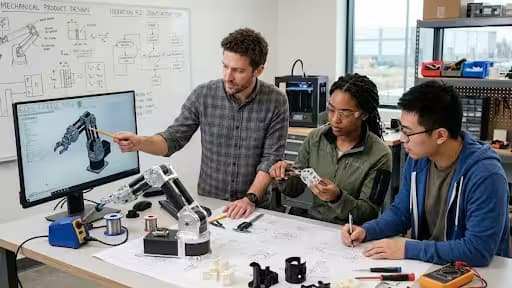
Mechanical Product Design Services for Better Innovation
Mechanical Product Design Services for Better Innovation
Making a product that is successful needs more than a pretty idea. The product should be functional, robust, long-lasting, easy to make, and appropriate to its intended purpose. Mechanical development is the process of engineering that transforms the initial concept into an accurate, tested, and ready-for-production product.
From household products to industrial equipment to specialized mechanical parts and devices that are specialized, development includes multiple phases. This could include the development of concepts and CAD modeling, as well as the selection of materials, prototyping, testing, refinement, and preparation for manufacturing. CAD Verse Engineering supports product development using CAD/CAM DFM, 3D printing, prototyping, as well as production services.
Starting With a Clear Product Requirement
Each mechanical item should start by establishing a clear concept of the purpose for which it was designed. Before drawing up detailed designs of 3D designs, the engineers have to be able to determine what the item will be expected to accomplish.
Important questions may include:
- What is the problem that this product will help to solve?
- How does the user interact with it?
- What forces or loads is it likely to encounter?
- What are the dimensions and weights needed?
- What materials are suitable?
- What will the final product be made of?
The early definition of these requirements provides an orientation for the whole mechanical development process, and can help avoid unneeded redesigns in the future.
Developing the Product Concept
Once requirements are established Once the needs are clear, different ideas are possible to explore. Sketches and initial ideas aid designers in comparing possible designs, structures as well as product designs.
In this phase, the objective is to come up with an option that is able to combine the practical requirements of engineering. The product might look attractive however, it may be challenging to build or construct and therefore feasibility needs to be taken into consideration along with the aesthetics.
Mechanical design usually is an iterative process that involves the definition of the problem, idea generation and prototyping. Testing, as well as design refinement.
Creating Detailed CAD Models
Once you have selected a design, the next step in mechanical development typically involves the creation of detailed 3D CAD designs.
CAD lets engineers define exact dimensions and design components as and whole assembly. Digital models can be utilized to analyze the relationships between parts and to determine potential design issues prior to the production of physical pieces.
Technical drawings, specifications, and bills of material can be created using drawings to express the manufacturing specifications in a clear manner. Modern workflows for engineering use CAD to establish a core connection between analysis, design, manufacturing, prototyping, and design.
Material Selection and Engineering Performance
The selection of the correct material is a crucial aspect of the process of developing a product. Selection of the right material will affect quality, strength, weight, appearance, durability, as well as the cost of production for the finished product.
A mechanical component might require a stiff material that is able to withstand repeated heavy loads. Another could require elasticity or resistance.
The materials should be chosen based on the purpose of the piece. Engineers can also employ various materials in the development of prototypes prior to selecting the final material.
Prototyping Makes the Design Testable
A CAD model is a valuable resource However, a real-world prototype may reveal difficulties that are hard to see on a screen.
With prototyping, engineers have the ability to test the dimensions, assembly motion, ergonomics, and functionalities. If there is a issue, it is possible for the CAD model to be modified and a different version of the design could be developed.
CAD Verse Engineering offers rapid prototyping of products and technologies such as SLA resin for precise prototyping, ABS for durable functional components, and TPU to create flexible and impact-resistant parts. It allows different prototyping methods to be chosen based on the specifications of the project's validation.
Testing and Improving the Design
Testing is one of the most important steps during the design of mechanical products. Based on the type of product being designed, the engineers will evaluate the performance of structural components, their movement in terms of fit, the durability of the product, its usability, and the behavior of materials.
Digital analysis also supports the physical testing procedure. Engineering software is able to analyze factors like stress and vibration prior to or in conjunction with prototyping tests.
The outputs are utilized to improve the design. The process could be repeated multiple times until the product fulfills the requirements of its creator and is dependable enough for production.
Designing for Manufacturing
The product that is working well as a prototype might need to be modified prior to mass production. Manufacturing processes come with specific requirements for parts geometry, tolerances, materials, assembly tools, as well as production costs.
Design for Manufacturing, or DFM, is a method of making things easier and more efficient to make while still keeping the quality that is required. A prompt DFM examination can assist in identifying insufficiently complicated features, overly high numbers of parts, or designs that could be costly to produce.
This step creates a crucial link between the mechanical design of the product and the manufacturing procedure.
Industries That Use Mechanical Product Design
Mechanical design is utilized across many industries. Products for the consumer market require mechanical design to create enclosures, mechanisms and even assemblies. Industrial machines may need intricate engineering to move components as well as structural systems.
Common applications are:
- Products for the home and consumer
- Industrial machinery
- Automotive components
- Sports equipment and fitness
- Medical devices
- Electronics enclosures
- Production equipment
- Custom-designed mechanical components
Every project is unique and has its own specifications, but the primary method of development remains centered on creating tests, improving and preparing the product that is suitable for the purpose it was designed.
Frequently Asked Questions
What exactly is the mechanical aspect of product design? Mechanical design of products is the procedure to design physical products and mechanical parts by using the principles of engineering, including CAD models, prototyping tests, and manufacturing preparation.
How important is CAD for the design of products? CAD aids engineers in creating precise 3D models, designing models, measuring dimensions, and gathering technical details before the actual manufacturing process begins.
What is the reason a product should be tested in a prototype? Prototyping lets engineers physically test the design and find potential flaws in fitting, functionality, assembly, and usability prior to manufacturing.
What is DFM? DFM refers to Design for Manufacturing. The focus is on improving a manufacturing process so that it can be made more efficient, with reliability, and at a lower cost.
Can an existing design of a product be made better? Yes. Current products may be modified through a review of their construction, materials, parts, as well as their functionality and production procedure to determine opportunities for improvements.
Final Thoughts
Mechanical design gives a clear route from the initial conceptual idea to a fully functional product. By combining the knowledge of engineers together with CAD modeling, material selection, as well as prototyping, testing, and DFM, companies can make more informed decisions about their product development before going to manufacturing.
An organized process can help minimize uncertainty, spot problems with design earlier to create items that are useful, secure, durable, and suited to be manufactured. The CAD Verse Engineering combination of prototypes, design, DFM, and support for production helps connect these steps, beginning with a concept for the product until the point of manufacturing.
Need help applying this to your product?
Discuss Your Project