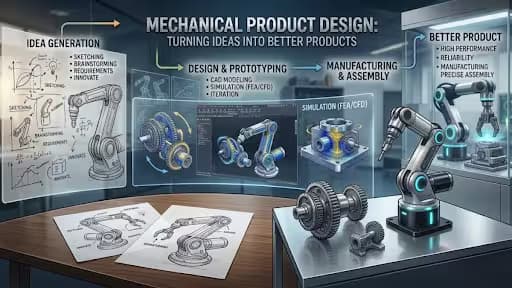
Mechanical Product Design: Turning Ideas Into Better Designs
Mechanical Product Design: Turning Ideas Into Better Designs
An effective product can't be made solely by its appearance. The basis of every successful mechanical product is an intricate combination of designs, technical decisions, and material choice, as well as manufacturing specifications, and even practical tests.
Mechanical Product Design integrates these components to turn an idea into a functional and detailed product which can be moved towards the manufacturing process and prototypes.
If the task involves the creation of a brand new product for consumers or industrial part, parts, enclosures, tools, or mechanical assembly, skilled design professionals can turn the idea into a product that is practical in the world.
From Rough Concept to Detailed Engineering
A lot of products start from a simple sketch: a reference image, a component that is already in use, or a basic concept. The trick is to turn the initial idea into a well-designed engineering model.
The development process could include:
- Becoming aware of the specifications for products
- Developing the initial idea
- Creating 3D CAD models
- Designing individual components
- Building assemblies
- The right materials to choose
- Revising manufacturing specifications
- Making prototypes
- Finalizing the design
Every stage assists in moving the product towards manufacturing.
What Makes Mechanical Design Different?
Mechanical design considers not just the way a design appears. It is about how it performs, interplay with other parts, carry the weight of items, and ultimately be made.
Professional designers may have to take into account:
Function
Each component must fulfill its purpose with complete confidence.
Dimensions
The accuracy of the dimensions is essential for elements that have to fit perfectly.
Materials
The chosen material must meet the product's environmental, mechanical, and production requirements.
Movement
Items that contain the following components: hinges, gears, springs, sliders, and shafts or any other moving components must be considered with care regarding the movement and clearances.
Manufacturing
- The design must consider how the components will be manufactured.
- This engineering approach can help minimize difficulties later during the process of development.
The Role of 3D CAD in Modern Product Design
The use of 3D CAD models has been an essential part of modern engineering design. Designers can develop precise digital models of parts and whole assemblies before when physical production commences.
A 3D CAD model could help teams:
- Visualize the product
- Verify component relationship
- Dimensions of the review
- Identify design conflicts
- Modify components quickly
- Make sure you have the right files ready for manufacture
- Create prototypes
Digital modeling allows you to experiment with the various concepts of design before leaping into physical manufacturing.
Designing Individual Parts and Complete Assemblies
Mechanical items are typically comprised of several components that must work in conjunction.
Designers can design individual components that they can then put together into a whole assembly to see how they interact.
Assembly-level design can help identify:
- Component interference
- Problems with clearing
- Incorrect dimensions
- Assembly areas that require a lot of effort
- Fastener locations
- Restrictions on movement
- Access problems
The process of identifying the problems digitally could be a lot easier than identifying the issues after they have been manufactured.
Why Design for Manufacturing Should Start Early
An image can appear stunning on a screen but be expensive or hard to create.
That's why Design for Manufacturing (DFM) should be considered when designing the product instead of only when the design is completed. DFM is designed to streamline production and reduce the complexity of production as well as improve the manufacturing process.
DFM concerns can encompass:
- Production process
- Material availability
- Part geometry
- Tolerances
- The number of components
- Assembly requirement
- Production quantity
- Tools and requirements for tooling
Being proactive about these issues can aid in reducing the need for redesigns as well as unnecessary production costs.
Making a Product Easier to Manufacture
- One of the goals of a professional mechanical design is to design an item that is not just functional, but feasible to manufacture.
- A component, for instance, can be designed to eliminate unneeded machining, reduce assembly, or reduce the number of parts that are separate and make the most efficient utilization of the manufacturing procedure.
- The smallest of decisions can make an impact on the final product as it moves from the prototype stage into production on a larger scale.
Prototyping Before Full Production
A digital model provides valuable information, but a physical prototype can reveal additional details.
Teams can use prototyping to assess the product in its final form and then analyze:
- Physical dimensions
- Component fit
- Ergonomics
- Assembly
- Function
- Appearance
- Behavioral requirements
Should changes be required, if CAD models need to be updated, they can be modified before moving on to higher production numbers.
This method of iteration could help enhance the final design.
3D Printing for Faster Design Validation
- 3D printing is a feasible method to create physical copies of digital images without making the investment in conventional production equipment.
- Prototypes for suitable projects are produced with different methods and materials, based on the specifications.
- CAD Verse Engineering provides 3D printing options, including ABS, SLA, and TPU, and offers businesses the option of different prototyping requirements.
- Physical feedback in a hurry can help designers spot issues before they occur and can make the design process easier and more effective.
Material Selection Is Part of the Design
The choice of materials can affect the quality, performance, weight, price, as well as the manufacturing process of an item.
In the case of a specific application, designers may need to think about materials, such as:
- Plastics
- Aluminium
- Steel
- Steel made of stainless steel
- Materials that resemble rubber
- Composite material
The most effective material isn't always the most durable or expensive choice. It must meet the item's requirements.
Factors like humidity, temperature, mechanical load and chemical exposure, the production procedure, and anticipated longevity of the service may affect the final decision.
Tolerances and Fit Can Make or Break an Assembly
If multiple mechanical components have to function together, the dimensional precision becomes crucial.
If the tolerances are not tight enough, manufacturing could become unnecessarily costly. If the tolerances are not tight enough, the components could move improperly or cease to perform according to the specifications.
When a Product Needs a Redesign
Mechanical design doesn't have to be restricted to new items.
Products that are already in use may require a modification if the company wishes to:
- Lower the cost of production
- Improve performance
- Replace an unavailable material
- Simple assembly
- Reduce the weight of your product
- Improve durability
- Make an old design available for contemporary production
- Correct recurring production problems
Redesigns can allow you to enhance the product's original features while keeping the functions that work very well.
Visualisation Before Manufacturing
A realistic rendering of a product can help firms understand how the finished product might look before manufacturing starts.
The use of visualisation with high quality can be helpful in the following areas:
- Presentations of the product
- Client Approval
- Marketing campaigns
- Product launches
- Internal design reviews
- Imagery for E-commerce
If a company is developing an innovative product, real-world images help explain the product's concept to all the customers, stakeholders, and manufacturers.
From Engineering File to Production-Ready Design
A well-designed mechanical design procedure should create more than a beautiful 3D design.
According to the scope of the project, the final engineering plan may comprise detailed CAD model drawings of assemblies, technical specifications along with manufacturing details, as well as files that can be used for prototyping and production.
Documentation that is clear and concise can help makers understand what exactly needs to be manufactured.
This is especially important as designs are shared among the engineering team, suppliers, and factories.
Common Design Problems Businesses Should Avoid
Many issues could cause unnecessary issues during the development of a product.
Designing Without Manufacturing in Mind
The inability to meet manufacturing standards at the last minute can cause costly modifications.
Overcomplicating the Product
The addition of more parts or features could increase the production process and difficulty.
Choosing Materials Too Late
The choice of materials can affect the whole design process, therefore, it is important to consider it in the beginning.
Skipping Prototyping
Making the transition from CAD into production on a larger scale could make it more likely to discover issues at the wrong time.
Ignoring Assembly
The product might be simple to make, but it can be it is difficult to put together. Each stage should be considered.
Focusing Only on Appearance
An item must fulfill the purpose it was designed for, not just look attractive.
Industries That Benefit From Mechanical Product Design
Mechanical design can be utilized in a variety of industries and types.
Examples include:
- Consumer goods
- Industrial equipment
- Automotive components
- Machinery
- Medical equipment
- Electronics enclosures
- Fixtures and tools
- Hardware and hardware products
- Production components
- Customized mechanical systems
The approach to engineering changes in accordance with the intended use of the product, the operating environment, and the manufacturing needs.
CAD Verse Engineering: Turning Designs Into Practical Products
CAD Verse Engineering offers engineering and product development assistance for companies who want to develop an initial idea into a real product.
The capabilities we offer include:
- Mechanical product design
- Design for Manufacturing (DFM)
- 3D CAD development
- 3D printing
- Prototyping
- Mass production
- Realistic rendering of product
Through a combination of design and manufacturing factors, CAD Verse Engineering can assist businesses in developing products that have more clarity from idea to actual manufacturing.
The prototyping capabilities we offer also meet diverse project requirements with the help of techniques and materials like SLA, ABS, and TPU.
When Should You Work With a Professional Design Team?
Engineering support from a professional could be beneficial in the event that a project is at the point that technical accuracy as well as manufacturing expertise are essential.
It is possible to benefit from a professional mechanical design of your product in the following situations:
- The product concept is great but there's no or CAD-based model
- Sketches that are rough and require engineering
- The design is in good shape but requires an upgrade
- Prototypes that require refinement
- Problems with manufacturing that require rethinking
- The product must be made for mass production
An expert engineering team will help you create innovative ideas that are able to be implemented in manufacturing needs.
Frequently Asked Questions
What is the mechanical component of a concept? Mechanical product design refers to the design process that engineers use to create mechanical components, products, and assemblies, taking into consideration the purpose, dimensions, material production, as well as practical usage.
The importance of 3D CAD? 3D CAD lets engineers develop and improve precise digital models, review designs, pinpoint possible design problems, and create models for manufacturing or prototyping.
What exactly is DFM for in mechanical design? DFM is a shorthand for Design for Manufacturing. It is focused on making goods easy and practical to produce while considering costs and quality, as well as materials and manufacturing methods.
Do you need to prototype for every item? Not necessarily. Prototyping is a necessity based on the nature of the product's complexity as well as the risk involved, manufacturing process, and needs. But physical prototypes may prove useful in confirming crucial design choices.
Is it possible to make an existing product change? Yes. Products that are already in use can be modified for better performance, to simplify production, cut expenses, modify materials, or fix design issues.
Can mechanical design include product rendering? Yes. The use of product rendering is used along with engineering design in order to make authentic visual representations for presentation, approvals, as well as marketing.
Conclusion
An efficient mechanical design brings ideas into line with the reality of manufacturing and engineering. It looks at how the item will function, the materials required, how the elements are connected, and the way it will be manufactured effectively.
From detailed CAD models and DFM to 3D printing, prototyping, rendering, and the manufacturing process, each stage contributes to a better final product.
If you are a business that is developing a brand new product or enhancing an existing one, expert mechanical design will provide the technological base needed to go from conception to manufacturing with more confidence.
CAD Verse Engineering provides prototyping, design, manufacturing, and the ability to visualize products together for businesses to help them along the development process.
If you've got an idea, an existing design, or a prototype that requires expert engineering assistance, CAD Verse Engineering can transform your ideas into a feasible, ready-for-production solution.
Need help applying this to your product?
Discuss Your Project