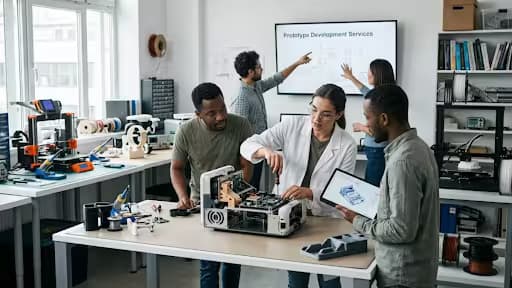
Prototype Development Services for Better Product Design
Prototype Development Services for Better Product Design
The process of transforming a product idea from concept to an actual product that is ready for market requires meticulous design, engineering, as well as refinement. Prototype development services aid companies, product designers, entrepreneurs, manufacturers, and startups in developing concepts into tangible or digital prototypes that may be tested prior to full-scale production.
A well-designed prototype gives you the opportunity to study what a product's appearance and function are in the real world. This can assist in identifying design flaws, enhance the usability of your product, decrease development risk, as well as provide a solid base for production.
In CADverse Engineering, prototype development will help you move through concept, engineering design, prototype development, and development.
What Are Prototype Development Services?
Prototype Development Services consist of creating an initial prototype of a component or product to evaluate its appearance and functionality, its dimensions, material, as well as its overall efficiency.
Based on the requirements of the project, the scope of a prototype may vary in size from a basic model up to an extremely practical engineering prototype. The design process usually involves CAD modeling as well as engineering analysis and material selection, production techniques, as well as testing.
Prototypes are designed for many different industries, which include the fields of mechanical engineering, consumer items, manufacturing equipment, automobile electronics enclosures as well as specialized machinery.
Why Prototype Development Is Important
Making a model before producing the final product may offer valuable insights into issues with the design.
The prototype can be used by engineers as well as firms to:
- Test product ideas
- Identify design problems early
- Test performance and functionality
- Improve product ergonomics
- Examine dimensions and determine installation
- Select suitable materials
- Reducing manufacturing risk
- Collect feedback from all your stakeholders
- Make improvements to the final design
When they spot problems at the prototyping stage, businesses are able to make adjustments before making a commitment to manufacturing.
From Concept to Prototype
The success of a prototype starts with an idea of the concept behind the product. Engineering team members review the relevant information, requirements for design dimensions, function, as well as the purpose for which it is intended.
The design concept then transforms into a fully detailed digital design by using computer-aided design software.
Concept Development
The initial step is to understand what it is that the product must achieve. Engineers look at the purpose of the product, the operating environment, its dimensions, functionalities, as well as materials and production needs.
3D CAD Modeling
When the design is decided, the engineers then create a precise 3D CAD design. This model gives an accurate representation of the concept and permits engineers to examine the geometry prior to physical development.
Design Validation
The CAD model may be analyzed in terms of dimensions, assembly possible interferences, clearances, and many other aspects of engineering.
Prototype Manufacturing
After the design has been finalized then the most appropriate method of manufacturing will be determined by the purpose of the prototype, its material quantities, as well as the required quality.
Testing and Refinement
The design is examined for areas in need of improvement. Modifications to the design can be integrated into the following version.
Types of Prototypes
Different types of products need different kinds of prototypes. The best approach is determined by the stages of development as well as specifications for testing.
Visual Prototypes
Visual prototypes are typically created for demonstrating the design's look and shape, dimensions as well as overall appearance. They may be helpful to present design critiques, presentations as well as early feedback from customers.
Functional Prototypes
Functional prototypes are made to illustrate how a certain part or item functions. They can be particularly helpful when the mechanical operation, movement, fitting, performance, or fit is required to be assessed.
Engineering Prototypes
Prototypes for engineering are designed with a greater emphasis on performance in terms of technical, material selection, dimension, and manufacturing issues.
Manufacturing Prototypes
Prototypes of manufacturing are designed in order to determine how an item can be manufactured by the process of manufacturing that was intended. They help to determine production issues before mass production begins.
Role of CAD in Prototype Development
Computer-aided Design plays a key part in modern prototype development. An elaborate CAD model lets engineers envision and alter a product prior to the production of a physical prototype.
The CAD model can assist with:
- Accurate dimensions
- 3D visualization
- Assembly Development
- Changes in design
- Engineering documentation
- Preparation for manufacturing
- Design Communication
Digital models also allow more efficient collaboration for engineers, designers, and manufacturers.
Benefits of Professional Prototype Development Services
Engaging with skilled engineers will help companies approach the development of products more effectively.
Reduce Development Risks
Early prototypes could reveal a problem before they turn into costly manufacturing challenges. Recognizing these issues during the development phase will reduce the chance of making major adjustments in the future.
Improve Product Design
A prototype test provides actual feedback, which can be utilized to enhance the functionality, look, usability, performance, and appearance.
Save Time and Resources
Even though prototype development involves the initial expenditure, it is a great way to avoid costly errors in production.
Support Manufacturing
An appropriately designed prototype could be a valuable source of information when choosing the manufacturing process and also making a product ready for manufacturing.
Improve Client and Stakeholder Communication
The physical or practical prototype could make it easier for users to comprehend the product better than sketches or even descriptions.
Prototype Development for Different Industries
Prototype Development Services is a tool that can be used across various manufacturing and engineering sectors.
Mechanical Engineering
Mechanical prototypes can be utilized to test mechanisms, components, housings, assemblies, tools, and equipment.
Automotive
Development of products for the automotive industry often calls for prototypes of components, brackets, enclosures, internal parts, as well as mechanical equipment.
Consumer Products
Prototypes for consumer products help companies assess the appearance of their product design, ergonomics, functionality, as well as user satisfaction.
Industrial Equipment
Machinery and equipment used in industry are able to benefit from prototype development to test parts, assemblies, and mechanical systems prior to production.
Electronics and Enclosures
Prototype development is also a way to support electronics by developing enclosures, mechanical components, and enclosures built around particular internal parts.
Materials Used for Prototypes
The right prototype material is based on the application in mind as well as the requirements for testing.
Common materials may be:
- Plastics
- Engineering polymers
- Aluminum
- Steel
- Steel made of stainless steel
- Composite material
- Specialized engineering materials
Selection of the material should be based on toughness, weight, endurance, and appearance, as well as temperature resistance, price, and production method.
Prototype Development and Product Testing
Testing is a crucial component of the process. The prototype may provide the chance to assess how the design performs under the expected operating conditions.
Based on the type of product being tested, the testing process may include:
- Dimensional inspection
- Functional testing
- Testing of the assembly
- Test of load
- Clearance and fit checks
- Evaluation of ergonomics
- Concerns about the environment
The results of testing can be utilized to further refine the designs.
Rapid Prototype Development
New engineering techniques allow engineers to create prototypes much faster than the traditional methods of development. Rapid prototyping methods can assist teams in creating models quickly and testing design ideas.
This is especially useful for businesses and startups that are working on tight schedules for development.
The rapid iteration process helps engineers go through the design-test-improve process quicker.
Custom Prototype Development Services
Each product is unique in its specifications for engineering. Therefore, prototype Development Services should be customized to meet the specific needs of each design.
A customized approach could include:
- Specifications for products
- Intentional application
- The dimensions that must be met
- Specifications for the material
- Process of manufacturing
- Prototype quantity
- The requirements for testing
- Production goals
- Project timeline
This ensures that the product's prototype fulfills a particular development need and is not just a visual representation of the concept.
Prototype Development Vs Final Production
Prototypes are not always like the final item. Their main purpose is to test and refine the product's design.
As they develop, engineers may find potential opportunities for:
- Simplify components
- Reducing the amount of material used
- Strengthen your muscles
- Lower production costs
- Improve assembly
- Change dimensions
- Improve accessibility
This can help aid in making the transition from prototype to production much more effective.
How CADverse Engineering Can Help
CADverse Engineering provides engineering-focused solutions specifically designed to assist businesses during the process of developing products.
Proficient Prototype Development Services can help develop engineering concepts into prototypes that can be tested. From design and CAD creation to prototyping, design and development, an experienced team of engineers will assist in establishing a well-organized procedure for development.
It is not just to design a prototype, however, but to create an idea that can provide useful details for the next phase of the lifecycle.
Conclusion
Prototype Development Services constitute a vital component of the modern process of design and development of products. They enable engineers and businesses to convert concepts into physical or digital designs that can then be examined, tested, and improved prior to production.
An appropriately designed prototype could assist in identifying design flaws as well as validate functions, increase the manufacturing process, and decrease the risk of development.
When you're working on an entirely new mechanical part or product for the consumer market, an automotive component, an industrial system, or a custom-designed engineering solution, prototyping will provide invaluable insights prior to making the leap to full-scale production.
Need help applying this to your product?
Discuss Your Project