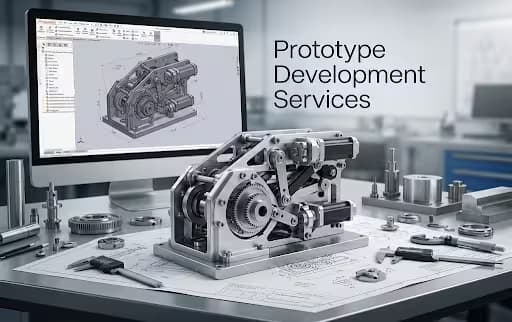
Prototype Development Services: From Concept to Production
Prototype Development Services: From Concept to Production
The prototyping development services offered by Prototype Development help businesses develop ideas for product concepts, products, as well as engineering concepts into functional or physical prototypes. The prototype gives you the chance to observe how a product functions, assess its style, discover any potential problems, and implement adjustments before moving to full-scale production.
If a company is developing new product concepts, creating prototypes is often crucial between the conceptualization phase and the final product. An appropriately designed prototype will help verify the dimensions, function, and assembly capabilities, the materials used, and the overall quality of the product, as well as reducing the possibility of making costly adjustments later during the process of development.
What Are Prototype Development Services?
Prototype development involves the creation of a functional or physical prototype of a product, built on requirements for design sketches, CAD models, and technical drawings or the engineering concept. The prototype could be a complete model or just the parts that need to be tested. Based on the scope of the project, prototyping can require a 3D CAD model, component design, selecting materials, manufacturing and assembly, testing, and even design tweaks. Its primary purpose is to transform an idea or concept into something that could be tested in a real-world setting.
Why Is Prototype Development Important?
A prototype can be used by businesses to assess a product prior to making a decision to invest in manufacturing on a large scale. The issues that might not be apparent in drawings or the CAD model may be simpler to spot with a tangible prototype readily available.
Professional prototype development can help businesses:
- Test product ideas
- Check the product's functionality
- Identify design problems
- Verify the dimensions of your component and ensure it fits.
- Review assembly specifications
- Review manufacturing materials and methods of manufacture
- Enhance the usability of products
- Cut down on unnecessary manufacturing cost
- Be aware of design and construction decisions
- Make sure you have the right products ready for production
The early testing phase can limit the risk of costly modifications to the design after production has begun.
Key Stages of Prototype Development
The prototyping process typically has several phases. The precise process is dependent on the specific product and its level of complexity, the intended use, and the manufacturing specifications.
1. Understanding the Product Concept
The first step is to understand the concept behind the product and the requirements for it. This could include reviewing sketch designs and designs that are already in use, as well as reference items, technical specifications, sizes, operating conditions, and their intended uses.
2. CAD Modeling and Design Development
The CAD model permits engineers to see individual components as well as complete assemblies prior to making the actual prototype. Dimensions, component relationships, clearances, dimensions, as well as other details of the design are able to be reviewed and modified in this phase.
3. Prototype Planning
Once the design is designed, the best prototyping method for development is then selected.
Methods may be based upon factors like:
- Size of product
- The material needs
- Complexity of design
- Needed precision
- Prototype quantity
- Intentional testing
- Project budget
- Future manufacturing procedure
A well-chosen approach could assist in creating a model which provides valuable information on the product to be produced.
4. Prototype Manufacturing
The design approved by the committee can transform into a real prototype by using a suitable manufacturing procedure.
Depending on the project's requirements, prototype components can be made using techniques including 3D printing, CNC cutting, sheet metal fabrication, molding, or any other production methods.
The process chosen must be suitable for the material, dimensions of the design, complexity, and function of the design.
Assembly and Evaluation
In the event that a product has many components, then the various pieces can be reassembled for a test of how they function when they are used.
The evaluation of assemblies can aid in identifying:
- Component interference
- Problems with clearing
- Incorrect positioning
- Assembly problems
- Problems with Fasteners
- Problems with alignment and fit
This stage may provide useful data prior to the production process starting.
Testing and Design Review
The prototype is able to be assessed in relation to the initial requirements for the product. The testing may be focused on the functionality dimension, usability, the assembly process, strength, mobility, and other requirements specific to the project.
Design Improvements
Prototype development can be an iterative procedure. When testing uncovers an issue, the CAD concept or design could be changed, and another prototype may be designed. The ability to make improvements in the prototype stage could help to create an improved and more stable product.
Types of Prototypes
Different kinds of products call for different types of prototypes. Which one is best depends on the reason for design and also the number of functional requirements.
Concept Prototype
- A prototype concept is typically utilized to show the fundamental concept, form, or the capabilities of a product.
- This can assist businesses as well as developers in visualizing their ideas before they invest in a specific design.
Functional Prototype
- An operational prototype is created to show how a particular product or piece of equipment is designed to function.
- It could be helpful for testing movement, interactions with components, operational functionality, as well as other requirements for practical use.
Visual Prototype
- The focus of a visual prototype is on the appearance of the item in terms of shape, size, and overall style.
- This can assist businesses in reviewing the look of products prior to production.
Engineering Prototype
- The engineering prototype is designed by paying more attention to the technological performance, material dimensions, functionality, as well as manufacturing specifications.
- It could provide valuable information to further develop engineering and production design.
Production Prototype
Production prototypes are designed in conjunction with the planned manufacturing procedure as well as the final requirements of the product in the back of your mind. It helps to determine whether it is appropriate for the production method planned.
Role Of CAD in Prototype Development
Computer-aided Design plays an essential function in today's prototype design. An accurate 3D CAD model could provide the base for creating the physical prototype.
CAD permits engineers to:
- Make exact 3D models
- Modify product dimensions
- Develop assemblies
- Make sure you know the relationships between components.
- Review clearances
- Create technical drawings
- Design changes can be made quickly
- Make sure you have the right files ready for manufacture
Design development using digital technology before physical production may help identify potential difficulties earlier in the production process.
Prototype Development for Product Testing
A prototype test can give important information on the way a product works in the real world.
According to the item, the test may be used to evaluate dimensions and movement, interaction between components with each other, the assembly process, usability, the material's performance, and additional technical specifications. Information gathered during tests is then used to make improvements before it is put into manufacturing.
Prototype Development and Design for Manufacturing
Prototypes should not just show the concept of the product, it should also offer the chance to look at the manufacturing specifications.
Manufacturing design involves the creation of products that can be made quickly and efficiently by using manufacturing processes that are appropriate.
During prototype development, engineers may consider:
- Material selection
- Production techniques
- Component dimensions
- Tolerancing in manufacturing
- The requirements for machining
- Sheet Metal fabrication
- Injection molding
- Assembly techniques
- Joining methods and fasteners
- Production quantities
Making these considerations early could assist in preventing manufacturing issues earlier in the process.
Benefits of Professional Prototype Development Services
Engaging with skilled engineers is a great way to gain valuable assistance through the entire process of product development.
Professional prototyping services for businesses can assist businesses in:
Reduce Development Risks
A physical test prototype could uncover design flaws prior to production.
Improve Product Design
The feedback from testing prototypes can be utilized to improve dimensions and components, as well as materials and the overall functionality.
Save Time and Costs
Recognizing problems in advance can cut down the necessity for costly changes when production is already underway.
Improve Manufacturing Readiness
The development of prototypes can ensure that the product's design is based on real-world manufacturing and assembly needs.
Support Better Decision-Making
The physical model gives companies the opportunity to test a product prior to making the decision to go for mass production.
Common Applications of Prototype Development
Prototype development are available across a variety of products and industries.
Common applications are:
- Consumer goods
- Industrial equipment
- Mechanical parts
- Automotive components
- Machinery
- Equipment and fixtures
- Electronic enclosures for products
- Metal products made of sheet
- Custom engineering products
- Mechanical assemblies
- Production equipment
The process of development can be modified to meet the particular needs of the product.
Common Challenges in Prototype Development
Prototyping products can present a variety of issues. One of them is turning a design idea into a functional prototype that is able to be produced and then tested.
Others challenges could comprise:
- Maintaining accurate dimensions
- Selecting suitable materials
- Limiting tolerances
- Managing component clearances
- Selecting the best manufacturing technique
- Ensuring proper assembly
- The balance between cost and performance
- Design changes that are efficient
- In the preparation of accurate documentation for manufacturing
Support from an engineer can be a great way to overcome these obstacles in the process of development.
Choosing The Right Prototype Development Service
In selecting a prototyping development service, it is important to consider the expertise of the service provider's engineers and capabilities in CAD and manufacturing experience, as well as their communication procedure, and the ability to grasp the needs of the project.
It's also important to assess whether the provider will be able to deliver the necessary deliverables for example:
- 3D CAD models
- Prototype-ready designs
- Technical drawings in 2D
- Models for assembly
- Modifications to the design
- Manufacturing documentation
- Product development support
Communication between the client and the engineering team is essential to ensure that the design is in line with the specifications.
Frequently Asked Questions
What Are Prototype Development Services? Prototype development involves the creation of practical or physical models of the products that are based on ideas such as CAD models, technical drawings and engineering specifications.
Why Is Prototyping Important? Prototyping is a way for businesses to test the functionality of their products, its dimensions and assembly capabilities, usability and even design prior to moving on to the full-scale production process.
Can a Prototype Be Made From a CAD Model? Yes. An accurate 3D CAD model could serve as the basis to create physical prototypes that is manufactured or a prototyping procedure.
What Industries Use Prototype Development? Prototype development can be found in a variety of different industries, including consumer products industrial, automotive equipment, manufacturing tools, machinery as well as customized engineering.
Can Prototype Designs Be Modified? Yes. prototyping is usually an iterative procedure. Tests and evaluation can help identify points that require improvement before the design is finalized for use in production.
How Do Prototype Development Services Support Manufacturing? The prototyping process gives the designer an chance to assess designs and materials, as well as tolerances, assembly and production specifications prior to the start of large-scale production.
Final Thoughts
Prototype development is an essential link between conceptual product and its final production. In transforming concepts and concepts into tangible or practical prototypes, businesses are able to evaluate their products, discover possible issues, and then make adjustments before going to production.
A well-organized prototype development procedure helps improve reliability of products as well as reduce risks to development and aid in making better manufacturing choices. If you're developing the next consumer item or mechanical part, an industrial equipment, or a customized engineering solutions, expert prototyping can assist in turning your ideas into a functional and ready for production.
Need help applying this to your product?
Discuss Your Project