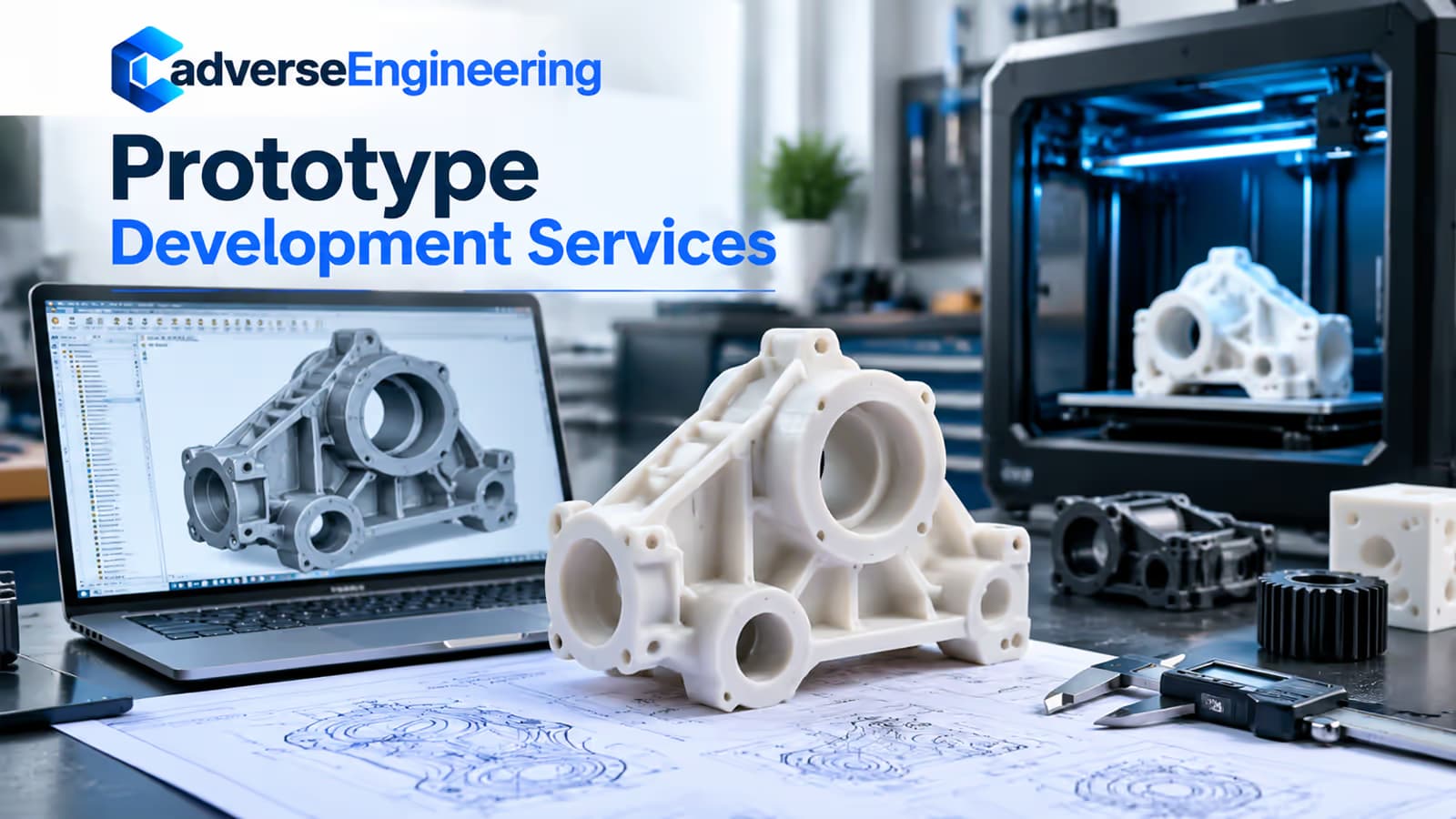
Prototype Development Services: Make Your Ideas a Reality
Prototype Development Services: Make Your Ideas a Reality
The process of taking an innovative idea and making it a functional product involves thorough planning, engineering, design assessment, and testing. To begin with, businesses must determine if their ideas are viable for making functional, practical, and manufacturable products before investing in mass manufacturing. Prototype development services are useful for startups, entrepreneurs, inventors, and established businesses alike.
A prototype is a model used to test the shape, size, look, fit, and some selected functions of a product before it is produced. It can also be used to make design changes when they are easier.
CAD Verse Engineering provides CAD Design, 3D Printing, Prototyping, and Design for Manufacturing (DFM) support for product development. Its approach involves the concepts and ideas for a digital product and the physical prototype and preparation for the next steps of development.
Whether you are creating a new consumer product, a mechanical part, or a customised product concept, using the right prototype development services can help make well-informed engineering decisions before making larger production investments.
Get a clear understanding of the engineering and prototyping services CAD Verse Engineering has to offer.
What Are Prototype Development Services?
Prototype development services assist in prototype creation from a product idea, sketch, reference image or CAD model on which the idea can be reviewed and evaluated. This may be a physical model, a working sample or a detailed design drawing.
Prototyping is used for testing out an idea before moving towards further development or production. By building a prototype, you will be able to identify dimensional problems, inappropriate geometry, assembly problems, or places where the design could be improved.
For instance, if a business is creating a new mechanical part, it may want to consider the size and installation of the part. A designer of a product might want to test the look of an enclosure, and an engineering team might want to test some selected functional requirements by testing a physical sample.
The methods used will vary depending on the purpose of the product, the materials involved, the design of the product, and the goals of the project.
There are several ways of developing prototypes.
Prototype development services are available in several types.
There are different ways of prototyping depending on the project. The choice of method will be determined by the learning that is required from the prototype.
1. Rapid Prototyping
Rapid prototyping helps to develop and improve product ideas by creating multiple designs. Teams can make a prototype, examine it, come up with changes, and make a new design, rather than having to wait until the design is finished.
It might be helpful in determining product size, product form, fit, or product functional needs.
2. 3D Printing and Physical Prototypes
Three-dimensional printing is a technology that converts a computer-generated model into a real object. It can be used for geometry and appearance evaluation, component fit, and some functional characteristics.
CAD Verse Engineering states that there are several 3D printing solutions available, such as:
- For prototypes that need fine details, SLA resin printing is an option.
- High-accuracy 3D printing: When the need for prototype parts is for a durable application, ABS printing comes into play.
- TPU printing: Flexible components.
Depending on the design, application and properties required, the suitability of the material is determined. For each project, the appropriate materials and printing techniques should be determined.
3. Functional Engineering Samples
Other prototypes have been designed to test beyond looks. Functional engineering samples can be used to examine selected product requirements, component interactions or assembly considerations.
Testing options for a prototype are dependent on the materials, manufacturing process and construction. The prototype does not necessarily mean the same as the product.
4. Design Validation and Refinement
Design a new structure, refine the design, and validate it.
Design validation is a review of a product against its requirements. Prototypes can be used to identify where dimensions, geometry, assembly, or usability can be improved.
The results of these evaluations can be added to the CAD model prior to further development.
Benefits of Prototype Development Services
Prototype development services bring several benefits, such as:
- Benefit — How It Helps
- Early Design Evaluation — Allows easier review of a concept prior to production.
- Design improvement — Identifies potential issues that need to be refined.
- Physical Evaluation — Provides teams a chance to see the actual shape and size.
- Improves communication — Provides a concrete model for stakeholders to discuss.
- Manufacturing preparation — Assists in determining design considerations before manufacture.
- Iterative development — Allows for changes as the project requirements become clearer.
While not all development hazards are avoided, prototyping can be helpful in offering valuable information prior to a business deciding to invest more deeply in manufacturing of the product.
The Prototype Development Process
A structured workflow helps to ensure that the prototype asks the right questions and will help to achieve the project goals.
Step 1: Share Your Product Concept
Start by explaining the idea, purpose, and project objectives. It is possible to submit sketches, photographs, dimensions, previous CAD drawings, etc.
Developing clear requirements can help to set the initial project scope.
Step 2: Perform a Design Review
The next step is to evaluate all of the information, technical restrictions, dimensions, and purpose. This review is conducted to identify what needs to be designed or improved prior to producing a prototype.
Step 3: Create or Improve the CAD Model
- The third step involves creating or improving the CAD model.
- The third step is to develop or update the CAD model.
- A digital model conveys the dimensions and geometry of the product. If there is an appropriate model, it might need to be modified to meet the needs of the prototype.
- CAD design can be used to clarify a concept and create a more detailed engineering representation, if necessary.
Step 4: Select the Prototyping Method
- It is unclear whether to select the prototyping method.
- There is uncertainty about the choice of the prototyping method.
- The manufacturing process and material should be chosen for the design. These factors can include the need for detail, flexibility, durability, geometry, and evaluation purpose.
- For instance, a complex graphical model could have different needs than a flexible part or a part for fit checking.
Step 5: Create and Test the Prototype
- In the fifth step, the team will create a prototype and test it.
- The fifth step is to design and test the prototype.
- The physical prototype can now be created once the design and method have been agreed upon. Then the sample could be checked against the agreed requirements.
- The evaluation can consist of appearance, size, fit, assembly, or a selected number of functions, depending on the project.
Step 6: Refine the Design and Plan Next Steps
- At this stage, the design is improved, and the next steps are planned.
- The design is refined, and next steps are planned at this stage.
The information gained from the prototype can be used to make design changes and for another development cycle. Following the review of the design, the project can move forward to manufacturing preparation, depending on necessary engineering checks and approvals.
Businesses That Can Benefit From Prototyping
Prototype development services can be used for all sorts of product development endeavors.
- Start-up Companies or Entrepreneurs: Test a product idea before larger manufacturing commitments.
- Product designers: Check shape, size, appearance, and design aspects.
- Engineering teams: Review fit of components and functional requirements that were chosen.
- Manufacturers: Identify potential design and production considerations as a manufacturer.
- Established businesses: Revise components or investigate new product ideas.
Depending on the product itself, its developmental phase, and the intended use of the prototype, the specific benefits will vary. Specialized testing and professional engineering evaluation may also be required for projects when performance or safety requirements are more complex.
Factors That Affect the Cost of a Prototype
The prototype development cost is dependent on the workload. Instead of assuming a fixed price, businesses should ask for a quote for their project.
Some of the key cost considerations are:
- Design complexity: The more intricate the design, or the more complex the assembly, the more engineering may have to be done.
- Creating a model from scratch is a different process than preparing an existing design for prototyping.
- Materials used for printing: Each material has varying characteristics and cost.
- Prototype size: The size of the prototype could be larger than anticipated, which may lead to increased material and production costs.
- Manufacturing method: Prep/Production/Finalization requirements will be influenced by the process chosen.
- Design revisions: Multiple revisions or prototype versions can expand the scope of the project.
- Testing requirements: Additional inspection/evaluation may require separate work for testing requirements.
- Project timeline: The project should be scheduled with specific requirements discussed before work.
To get a good quote, include the product concept, drawings or CAD files (where available), size, purpose, material preferences, scope, and timeframe.
What Makes CAD Verse Engineering a Good Option?
CAD Verse Engineering allows designers to combine several phases of product development: CAD Design, 3D Printing, Prototyping, DFM (Design for Manufacturing) and Manufacturing Support. This pairing can be useful for businesses when they're talking about their design needs both as they're creating a prototype and as they're preparing for production.
The company offers SLA resin, ABS, or TPU printing services, as well as rapid prototyping, functional engineering samples, and design validation services. This will vary depending on the project specification and should be verified with the engineering team.
Having a clear scope of work, agreed deliverables, and technical review are essential steps on the path from a concept to a physical sample for businesses.
For more information on the CAD Verse Engineering product development process, visit their website.
Frequently Asked Questions
They provide a means of creating a digital or physical model of a product to verify the design, size, look, fit, and chosen functional features of that product before any additional development or production.
What Is the Benefit of Rapid Prototyping in Product Development? Rapid prototyping helps with iterative design. The teams can see the prototype and discuss ideas for how to improve it, then use those ideas to create new versions of the prototype.
What Are Some of the Materials That Can Be Used for 3D-Printed Prototypes? Depending on the use, the right material will be used. CAD Verse Engineering offers printing with SLA resin, ABS, and TPU, the latter being suited to various design needs.
Can I Make a Prototype From a Sketch? A sketch can provide a starting point for a prototype project. The amount of engineering work needed is a function of the dimensions available, the complexity of the design, intended use, and what information is required to create an adequate CAD model.
How Much Do Prototype Development Services Cost? The cost of each project is unique. The costs vary depending on the design complexity, materials, size, manufacturing, engineering needs, and the number of revisions. If a price is being quoted, it will be specific to the project.
Is the Prototype Suitable for Mass Production? A prototype can be used to prepare a design for manufacture but not necessarily ready to go into mass manufacture. Other design reviews, material selection, production planning, material testing, and quality review may be required.
Transform Ideas Into a Prototype Product
The prototype is an important part of developing an initial idea into something practical that can be assessed, refined, and ready for the next stage of product development. Checking the design in advance reduces businesses' risk of material failures, geometry issues, and errors in function and manufacturing.
CAD Verse Engineering provides CAD design, 3D printing, prototyping, and manufacturing preparation solutions to assist at various phases of product development.
Looking for a product idea to develop? Go to CAD Verse Engineering's services page and share your concept, technical requirements, and project goals to discuss an appropriate path from concept to prototype.
Need help applying this to your product?
Discuss Your Project