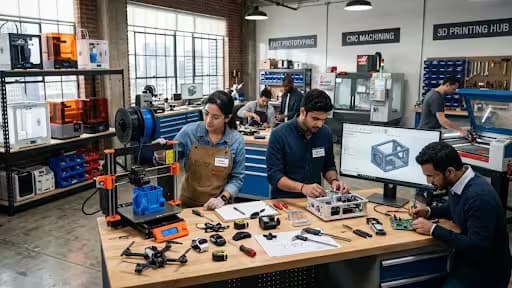
Prototyping Services: Turning Product Concepts Into Reality
Prototyping Services: Turning Product Concepts Into Reality
The idea of a product is more attainable to assess by having it observed, handled, and tested on a physical basis. Prototyping is a vital element of modern-day design and development. Before committing to large-scale manufacturing, companies can build prototyping models to see the way a product appears as it is constructed, how it fits into the overall design, and works.
A prototype helps reduce uncertainty during development. Instead of rushing from an idea to manufacturing, engineers and designers are able to test their ideas as they identify flaws and implement improvements. 3D printing, CAD modeling, and testing through iterative steps have made the process quicker and easier for entrepreneurs, companies, business owners, as well as product creators.
The Purpose Behind Product Prototyping
A prototype isn't just the display model. The purpose of a prototype is determined by the level of development and the issues that have to be addressed.
The first version of a model can be utilized to determine if an idea is feasible. Later versions could focus on assembly, dimensions, motion, or even user interaction. Functional models allow you to evaluate the performance of components before costly production decisions are taken.
Professional prototyping workflows usually involve review of the idea, planning the prototype, evaluating its functional and fit, revising the concept, then preparing the prototype for the next phase.
Different Prototypes for Different Requirements
Concept Models
Concept prototypes are often one of the initial physical prototypes of a product. The primary purpose of a prototype is to communicate ideas and to review the overall design and form.
They can prove helpful when discussing the innovative product with colleagues, customers, investors, or clients.
Functional Prototypes
Functional prototypes focus on efficiency. It is used to study moving parts, assemblies, connections, the strength of components, as well as other useful characteristics.
Early testing of these areas can assist in finding design flaws prior to the start of production.
Visual Prototypes
Certain projects need a model that is close to the look of the finished item. Shape, surface finish dimensions, proportions, and details are more crucial in this phase.
Visual models are helpful to present demonstrations, presentations, or review of products.
How 3D Printing Supports Prototyping
The advent of 3D printing has revolutionized how prototypes are created. Digital CAD models is able to be created and transformed into a physical component without the need to create traditional manufacturing tools.
It allows engineers to change the design and then create revisions more quickly. Techniques like FDM and SLA are able to be chosen depending on the needed strength and detail, as well as the finish of the surface and the use.
One example is that a prototype could be made primarily for testing dimensions, whereas other versions may employ an alternative material for testing its flexibility and mechanical capabilities.
CAD Design Before Fabrication
- An efficient prototype typically begins by creating a precise CAD model.
- Digital design specifies the dimensions, geometrical components, and other features of the item before production starts.
- When testing uncovers a flaw, the engineers are able to change the model in CAD and create a new prototype.
- The result is a continuous sequence of design, fabrication test, improvement, and testing.
- Designing with CAD can also help teams assess whether the design could be put together and what adjustments are needed prior to going to production.
Material Selection Matters
The materials used to make a prototype must be compatible with the purpose for which it was designed. The model designed to be used for display may need smooth surfaces and a detailed design, whereas a practical part may require greater toughness or flexibility.
The most commonly used 3D printing materials are PLA to print models quickly, PETG for durable parts, ABS for tougher applications, and TPU for applications where flexibility is necessary. Your choice of materials must be determined by the particular testing goal, not aesthetics alone.
Testing Before Full Production
One of the greatest advantages of prototyping is the possibility to try out a concept prior to making a decision on production in large quantities.
Testing can help evaluate:
- Part dimensions and fitting
- Connecting components
- The movement of products and their function
- User interaction
- Material performance
- Structural design
Prototyping a design and identifying a flaw is usually easier as opposed to identifying the issue when manufacturing or production is already underway. The rapid iteration process allows teams to improve designs based upon physical feedback.
From Prototype to Manufacturing
An effective prototype may not necessarily mean that an item is ready to go into mass production. More engineering is required to increase manufacturability, including the selection of materials, assembly procedures, and production efficiency.
The prototyping stage can provide valuable details that support the decisions made. When the crucial design concerns are answered, then the product is able to move into the manufacturing process with more certainty.
Frequently Asked Questions
What is prototyping? Prototyping can help turn the idea of a new product or concept into a tangible model to be tested, evaluated for improvements, or presented.
What is the significance of a prototype? Prototypes allow engineers and designers to pinpoint any potential issues in fitting, design, or performance prior to going into costly production stages.
What is the number of prototypes necessary? There's no standard number. Certain products that are simple may need just one or two variations, and more complicated products could undergo multiple iterations until the final design is approved.
What can I do to make a prototype with just an idea? Yes. Sketches, reference images, or even a technical need can develop into a CAD design before production of the final prototype.
What's the main difference between an initial prototype and a finished item? Prototypes are created to test, validate, or for development. The final product is produced in accordance with the design that has been finalized and the production specifications.
Final Thoughts
Prototyping can be a vital link between a product's initial concept and its final production. Through the creation of physical models, evaluating their functionality, and then refining the designs, companies are able to make more informed decisions about development.
If the objective is to design a minimal conceptual model or to test the functionality of a product, prototyping is a great way to create ideas that can be implemented in the real environment and offers valuable feedback before you can move forward in manufacturing.
Need help applying this to your product?
Discuss Your Project