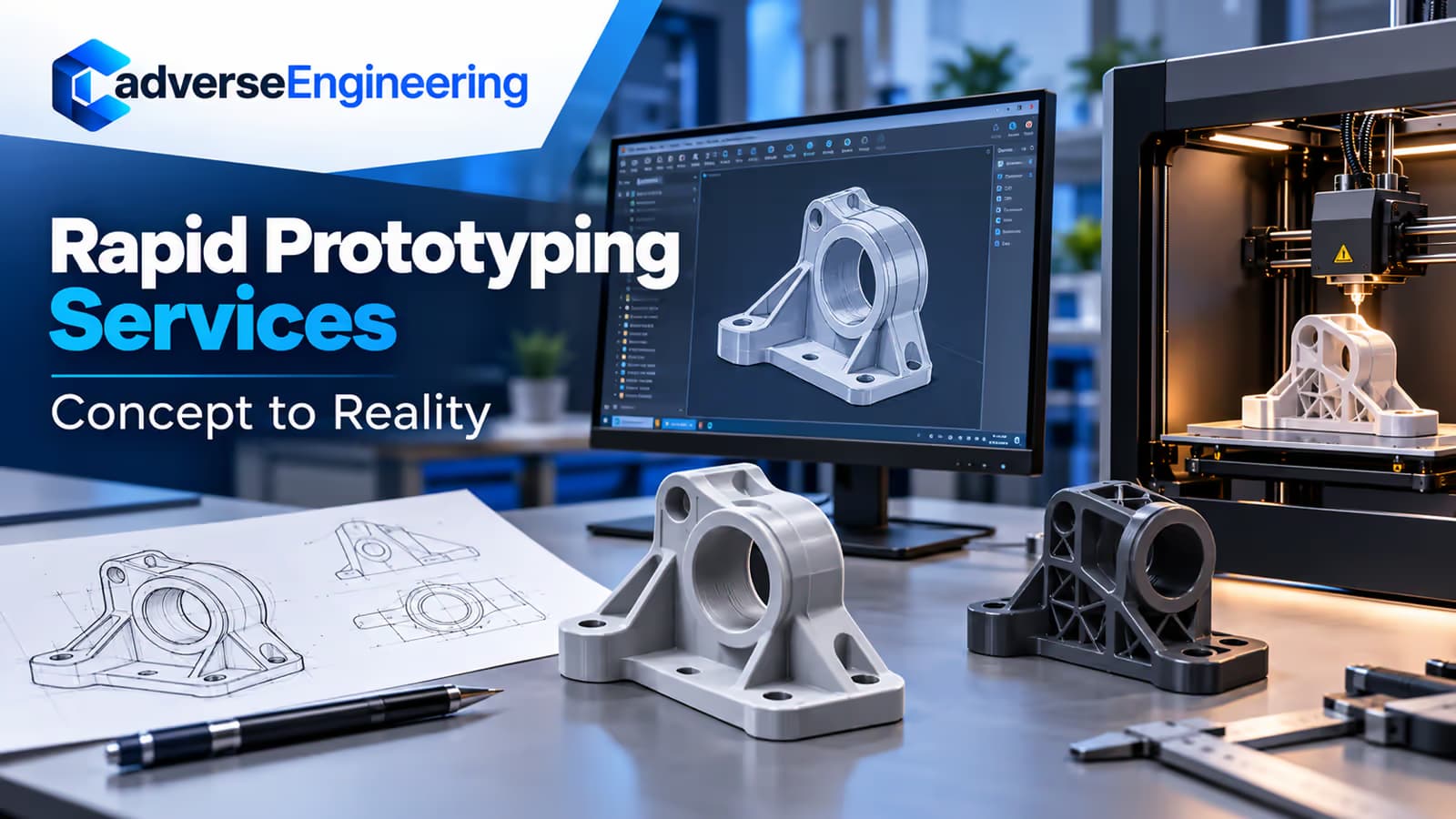
Rapid Prototyping Services: Concept to Reality
Rapid Prototyping Services: Concept to Reality
A product idea is not enough for the creation of a new product. Businesses must check designs, dimensions, materials, and engineering needs before they make a product. Digital designs can be converted to physical models through rapid prototyping services to help develop and refine the design.
Prototyping is a method for businesses to assess products before committing larger resources and find out design problems early.
CAD Verse Engineering provides CAD design, 3D printing, rapid prototyping, Design for Manufacturing (DFM), and manufacturing preparation services. These services connect digital concepts with physical prototypes.
What Are Rapid Prototyping Services?
Rapid prototyping is a service that provides a tangible representation of a product design to teams for further development or production. The project can begin with a sketch, a reference image, an existing CAD model, or the project's product requirements.
The idea is then turned into a digital design and created as a physical prototype with an appropriate method, like 3D printing.
A prototype can be used to evaluate:
- Product size, shape, and appearance.
- Fit and assembly of components.
- Design geometry and tolerances.
- Selected functional requirements.
- Design changes that may occur before manufacture.
It is used to help teams learn from a model and enhance the design.
Benefits of Rapid Prototyping
1. Evaluate Designs Earlier
A physical sample can show problems that you can't discern on a screen. Teams may check the dimensions, shape, and fit of parts before moving on.
2. Improve the Design
Prototyping can be used in an iterative process. Once they've looked at a model, designers can make changes to the CAD design if necessary and make another version, which can help locate possible issues prior to making bigger production commitments.
3. Improve Communication
Physical models allow stakeholders to consider the product's form, size, and qualities.
4. Support Manufacturing Preparation
A prototype is used to explore materials, geometry, assembly, and manufacturing considerations. In combination with design for manufacturing, it can contribute to the transition towards production. It cannot eliminate all engineering risks.
Types of Rapid Prototyping and 3D Printing
The appropriate method will depend on the product, the level of detail needed in the prototype, the nature of the material, and the intended uses of the prototype.
SLA Resin Printing
SLA resin printing may be suitable for prototypes that need finer detail and a smooth surface. It can assist with the review of complex geometry and features. Appropriateness will vary for different uses.
ABS 3D Printing
ABS printing might be appropriate for creating prototypes that need durable plastic components. It can be used to evaluate some mechanical characteristics, depending on the design and printing conditions.
TPU 3D Printing
TPU is a flexible material that might be appropriate for components that need flexibility as opposed to hardness. Suitability will vary depending on geometry and purpose.
CAD Verse Engineering offers 3D printing, including SLA resin, ABS, and TPU. For more details, check out the engineering services page.
The Rapid Prototyping Process
To make the most out of the rapid prototyping process, consider the following steps.
Step 1: Share Your Product Idea
Explain the idea, purpose, and objectives of the development. Present sketches, reference images, dimensions, existing CAD files, or other technical information.
Step 2: Define Requirements
Examine the product's size, composition, purpose, and constraints. This helps determine what the prototype must demonstrate and which parts should receive special focus.
Step 3: Create or Improve the CAD Model
The idea is turned into a digital model, or an existing CAD drawing is modified. This may necessitate extra engineering for complex parts.
Step 4: Evaluate the Material and Method
Select a method based on detail, flexibility, durability, size, and intended evaluation.
Step 5: Create and Test the Prototype
Create a prototype and examine its form, size, fit, construction, or chosen functionality.
Step 6: Improve and Develop Action Plans
Feedback may be used to inform revisions before manufacturing preparation, subject to engineering checks and approvals.
Who Can Benefit From Rapid Prototyping?
- Business or Professional — Potential Application
- Startups and entrepreneurs — Try out a concept before a bigger investment
- Product designers — Look at shape, size, and features
- Engineering teams — Check fit and geometry of components
- Manufacturers — Determine the design factors to consider in production
- Established businesses — Make improvements to components or create products
The best method can vary according to the product and evaluation needs. Specialist testing may be required for products that need to be safe for critical use.
What Factors Influence The Cost of Rapid Prototyping?
The cost will depend upon the project. Common factors include:
- Complexity of the design: If the design is complex, it may need more CAD work.
- CAD preparation: Model preparation differs from design preparation.
- Material and size: Cost is related to material properties, material quantity, and production time.
- Manufacturing method: The preparation and manufacturing requirements of each process are different.
- Revisions and testing: Additional versions, inspections, or evaluations can add to the project scope.
- Timeline: The scheduling requirements should be discussed and agreed upon beforehand.
If a useful quotation is required, include the concept, drawings, CAD files, dimensions, intended use, material requirements, deliverables, and timeframe.
Why Choose CAD Verse Engineering?
CAD Verse Engineering combines CAD design, 3D printing, rapid prototyping, design for manufacturing, and manufacturing preparation. It has SLA resin, ABS, and TPU options listed for printing.
Review the project scope, deliverables, materials, testing needs, and timeline with the engineering team.
Learn more about CAD Verse Engineering and its engineering services.
Frequently Asked Questions
What Are Rapid Prototyping Services Used For? They develop physical models for teams to assess the shape, size, appearance, fit, and chosen functions of a product prior to further development or manufacture.
What Materials Can Be Used for the Creation of 3D Prototypes? CAD Verse Engineering has SLA resin, ABS, and TPU options. The material depends on the design and application.
Could a Prototype Be Used for Functional Testing? Yes. The suitability of its use in real operating conditions will depend on the materials used, manufacturing process, design, and testing done.
What Is the Price of Rapid Prototyping Services? The cost varies based on the complexity of the design, CAD preparation, material, size, manufacturing method, revisions, and testing. The most accurate estimate of the cost is a project-specific quotation.
Would a Prototype Be Suitable for Mass Production? Not necessarily. Additional engineering reviews, material selection, manufacturing plans, testing, and quality checks may be necessary.
Begin Your Rapid Prototyping Project
Rapid prototyping creates physical models of various products to test and improve them before embarking on larger manufacturing volumes. CAD Verse Engineering provides CAD design, 3D printing, prototyping, and manufacturing preparation.
Looking for ideas for the development of a product? Explore the CAD Verse Engineering services page, share your idea, technical needs, and objectives, and discuss the process of moving from concept to prototype.
Need help applying this to your product?
Discuss Your Project