Rapid Prototyping Services For Faster Product Development
Rapid Prototyping Services For Faster Product Development
Making a concept into a tangible and testable product requires more than just sketching out a simple digital model. Product designers and engineers need to be able to comprehend how their concept will appear, look in the market, and perform prior to moving on to full-scale production. This is the reason why rapid prototyping and services are an integral component of the design creation process.
Rapid prototyping enables entrepreneurs, companies, startups, and inventors to design physical models of their concepts within a quick development time. The prototypes may be utilized to test sizes, shape, functions, assembly, materials, and other design aspects prior to investing in production on a large scale.
What Are Rapid Prototyping Services?
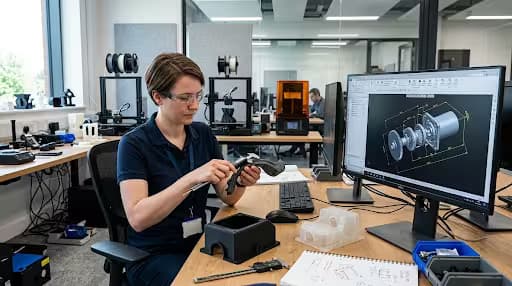
Rapid prototyping is the process of creating physical prototypes of digital product models using the latest technology for manufacturing and fabrication. The procedure usually starts with an initial 3D model in CAD and then transforms the digital model into a tangible prototype.
Based on the needs of the project, various techniques and materials may be utilized. The choice of method will be based on the size of the prototype, the geometry, strength requirements, as well as the finish of the surface, its planned application, and the production phase.
Its primary goal is to provide product designers with something tangible to study and try before they commit to manufacturing.
Why Rapid Prototyping Matters In Product Development
The traditional process of developing a product can require numerous design changes before the final product is finalized. The production of a final product at each stage of development is costly and takes a lot of time.
Prototyping in rapid fashion allows you to discover design flaws early. Engineers can examine the physical model, then compare it to the concept, and make the required adjustments prior to moving forward.
This could help:
- Verification of design
- Functional testing
- Checks for fit and assembly
- Formal evaluation
- Product demonstrations
- Customer feedback
- Preparation for manufacturing
Identifying a design flaw in the prototyping stage could help reduce the possibility that the issue will be discovered when production is already underway.
From 3D CAD Model To Physical Prototype
- The procedure generally starts by creating a precise digital model. CAD software lets designers design dimensions, geometries, elements, as well as other features before it can be converted into a tangible prototype.
- When the model is created, the appropriate prototyping technique is then selected.
- The digital model is created according to the specifications of the technology used in manufacturing.
- Following production, the prototype will be tested and inspected.
- The feedback received from this test phase could result in further design changes prior to moving the product into production.
Common Technologies Used For Rapid Prototyping
The various prototyping methods are appropriate to different needs of the product. Selecting the appropriate process is crucial since each process has its own unique properties.
3D Printing
3D printing is extensively used to make prototypes using intricate geometries as well as custom designs. Engineers can create tangible models by generating digital models without traditional tools.
Different 3D printing techniques support different types of materials, applications, tolerances, and specifications for surfaces.
SLA Prototyping
Stereolithography, also referred to as SLA, utilizes a light-based procedure to make high-quality prototypes made of resin. SLA is a great option in situations where fine-grained details, appearance, as well as seamless surfaces are crucial.
The most common uses for it are conceptual models for product development, visually-based prototypes concepts, validation of concept, and applications that need detailed functions.
ABS Prototyping
ABS is a widely used engineering plastic, which is appropriate for functional prototypes when the durability of the material and testing on a practical basis are needed. ABS prototypes are a great way for engineers to examine the physical shape assemblies, physical form, as well as certain specific functional properties.
TPU Prototyping
TPU is a flexible substance that is suitable for use for prototypes that need elasticity or characteristics that resemble rubber. TPU is suitable when designing products with flexible parts such as seals, grips, protecting parts and other areas where flexibility is required.
Benefits Of Using Rapid Prototyping
One of the main benefits of rapid prototyping its capability to change from a design in digital format to a tangible model without having to wait until full production.
Faster Design Validation
A tangible prototype gives an easier understanding of how an item will appear and feel when compared with an online model on its own.
Easier Design Changes
When an issue is found If an issue is discovered, when an issue is discovered, the CAD model is able to be altered and a different prototype made. This allows for an iterative development procedure.
Reduced Development Risk
A prototype test prior to manufacturing could help you identify any potential issues with regard to dimensions, assembly usability, and design functionality.
Better Communication
An actual prototype could help designers, engineers, manufacturers, customers, investors, as well as other parties to grasp the concept behind a product.
Improved Manufacturing Preparation
Design prototypes can show aspects that have to be altered prior to the item is placed in a bigger manufacturing process.
Rapid Prototyping For Product Design
Rapid prototyping is tightly linked with engineering design of products. The product might appear correct on paper, however, it will behave differently when its physical components are put together.
In the case of two components, they might appear to be compatible in CAD, but they require modifications due to tolerances, clearances, and material behavior or assembly specifications.
Making a prototype gives you the opportunity to pinpoint problems prior to manufacturing. Engineers are able to refine the model and design an improved version that is suitable and can be manufactured.
Rapid Prototyping For Startups And New Products
Businesses and startups that are developing innovative products usually need to try the concept before making an investment in manufacturing.
The prototype is a great way to show concepts to prospective customers or investors, producers, or business allies. They can also give valuable information during the early stages of product design.
Instead of rushing from the initial idea into mass production, companies could use prototypes as a way to gradually improve their products.
Prototype Testing And Design Refinement
Making the prototype is just one aspect of the procedure. Evaluation and testing are equally crucial.
In accordance with the model, the engineers will look at:
- Physical dimensions
- Component fit
- Process of assembly
- Functionality and movement
- Ergonomics
- Surface Finish
- Materials and their properties
- Manufacturing issues that could be a concern
Test results from prototyping will then be integrated into the design CAD. This method of testing lets the product improve before production.
Choosing The Right Rapid Prototyping Process
Every prototype shouldn't be made by using the same process. What is the right procedure depends on the intent for the design.
If your goal is to assess the appearance of the model and its detailed geometries, a high-detail manufacturing process could be a good choice. If the design needs to show flexibility or mechanical properties, the materials and manufacturing process may have to be selected in a different way.
Considerations to be important include:
- Product geometry
- Dimensions that are required
- The material needs
- Prototype quantity
- Essential requirements for functional use
- Surface Finish
- The requirements for testing
- Development budget
- Production method with a purpose
An experienced engineering team will examine these elements and recommend the most appropriate prototyping method.
Rapid Prototyping Vs Traditional Manufacturing
The traditional manufacturing process is highly efficient for production. However, it could require tools, molds, fixtures, or some other form of process based on the particular item being manufactured. Rapid prototyping generally focuses on validation and development rather than replacing all manufacturing methods.
These two methods can be used in tandem. An initial prototype could be designed in order to first validate your design. The process of manufacturing will be chosen later based on manufacturing volume, requirements for material costs, as well as specifics of the product.
How Professional Rapid Prototyping Services Help
- Proficient rapid prototyping and design services will bring together CAD design and engineering skills, materials selection, prototyping technology, experiences in product development.
- Instead of using the prototype to create an unrelated physical model, engineer-oriented services can think about how the prototype can be integrated into the entire production process.
- It could involve reviewing the design, noting potential problems, choosing an appropriate prototyping technique, making the prototype and assisting in further design improvement.
When Should You Use Rapid Prototyping?
Rapid prototyping may be beneficial in various stages of design. It is an option as a solution when a concept is in need of physical verification, or when an CAD design must be evaluated, or if an existing design requires changes.
This can be helpful when you are considering investing in tooling or production in larger quantities.
A prototype that is used in the right stage of development provides valuable feedback on physical properties and assist developers in making more educated engineering choices.
Frequently Asked Questions
What Are Rapid Prototyping Services? Rapid prototyping is a method of creating tangible prototypes for products based on digital blueprints using the right fabrication and manufacturing technologies.
How Does Rapid Prototyping Help Product Development? This allows engineers to visually test the product prior to the final production. It can be helpful to pinpoint issues with regards to dimensions, design as well as assembly, design, and even functionality.
Which Materials Can Be Used For Rapid Prototyping? Materials selection is contingent upon the application. Most commonly, the options include the engineering plastics, resins and flexible materials like TPU.
Is 3D Printing Used For Rapid Prototyping? Yes. 3D printing is one the more popular technologies utilized to speed up prototyping since it is able to create tangible models by utilizing digital CAD drawings.
Can Rapid Prototyping Be Used For Functional Products? Yes. Based on the material selected and manufacturing method prototyping can be made to be used for various kinds of engineering tests and functional assessment.
Is Rapid Prototyping Suitable For Startups? Rapid prototyping is a great option for entrepreneurs because it allows startups to test physical prototypes the product's concepts prior to investing in manufacturing.
Final Thoughts
Rapid prototyping is now a crucial aspect in modern-day product development due to the fact that it links digital engineering to real-world product testing. Instead of completely relying on a computer-generated model, designers are able to create an actual version of their idea, analyze it, find potential flaws and refine the design prior to manufacturing.
From 3D printing to SLA, from 3D printing and SLA to ABS as well as TPU prototyping the best technology will depend on the model's specifications as well as the testing needs. By using the help of professionals who provide rapid prototyping solutions, engineering firms and companies can follow a well-planned process from the concept stage and then engineering CAD designs to create a more sophisticated, ready for production.
Need help applying this to your product?
Discuss Your Project