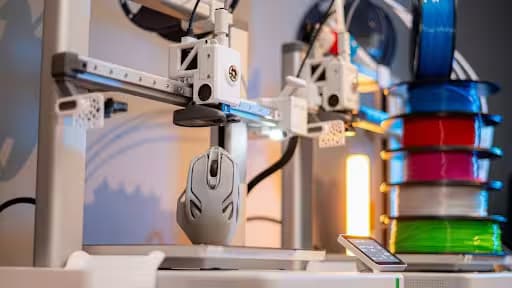
Rapid Prototyping Services UK: From Ideas to Tested Products
Rapid Prototyping Services UK: From Ideas to Tested Products
Making a brand new product requires more than just an idea. Prior to investing in tools or full-scale production, companies have to know how their product would look, feel, and work in real life. Rapid prototyping and design services in the UK assist product teams in moving from concepts in digital form to actual designs quickly, which makes it simpler to evaluate and refine a product prior to the production process.
For inventors, entrepreneurs, engineers, companies in engineering, as well as established enterprises, rapid prototyping is a great way to decrease the uncertainty of development. Models created in CAD can be transformed into physical prototypes for shape, fit, and form assessment, which allows design modifications to be implemented before major production costs are incurred. CAD Verse Engineering supports this process by allowing CAD development, rapid prototyping and printing, SLA/ABS/TPU test support, as well as manufacturing preparation.
Why Businesses Use Rapid Prototyping
Traditional development of products may require long processes prior to when a tangible product is readily available. If an issue with the design occurs late in the process, resolving the issue could incur costs and time.
Rapid prototyping solutions UK offer an easier way of working by permitting teams to create physical models earlier in the development process. They can help identify issues regarding dimensions, assembly functionality, or interaction between components which may not show up when viewed as a digital model.
The ability to experiment and modify to produce an additional version helps speed up the development time to develop. UK prototyping firms typically employ fast processes to test the form, fit, and performance before tools are put into place.
Turning CAD Designs Into Physical Prototypes
The rapid prototyping process typically starts with a CAD document. Engineers design a precise 3D model of dimensions, geometry, and other features of the item.
The digital image can be created for a suitable production method. Based on the design's intended use, it is possible that the design team will prioritize surface details quality, precision in dimensional measurements, the ability to move, strength, or speed.
CAD Verse Engineering works with conceptual sketches or CAD models that allow for the creation of physical prototypes. It also allows iterative design development and validation prior to manufacturing. The process is a progression from discovery and design to prototype validation and the handoff of production.
Selecting the Right Prototype Technology
Each product may not require the same method of prototyping. It is important to select the right technology in accordance with the requirements of the prototype to prove.
SLA for Detailed Models
SLA 3D printing could be helpful when precision as well as surface quality are essential. This is why it's ideal to create presentation models as well as detailed concept designs for products.
ABS for Functional Components
ABS is a good material to create prototypes that need greater endurance and practical testing of functional testing. ABS is a good choice in cases where a component needs to be able to handle more challenging tests.
TPU for Flexible Parts
TPU is a great option for parts with a need for flexibility or resistance. TPU can assist engineers in testing the performance of products that incorporate bendable, soft, or flexible components.
CAD Verse Engineering specifically offers SLA resins for prototypes with high detail, ABS for durable functional components, and TPU to create resilient, flexible components.
Testing the Product Before Manufacturing
One of the main benefits of using rapid prototyping UK is the possibility to evaluate a product prior to making a final decision on its production.
The prototype is able to be evaluated on its size, dimensions, movement, assembly, as well as usability and functionality. If tests reveal an issue, engineers can modify the model in CAD and then create new versions.
This process is designed to help the development team make better decisions by using physical feedback, not making assumptions on their own. Rapid prototyping is frequently used to create multiple prototypes for tests and evaluations, and various manufacturing techniques can be used to support both functional and visual prototypes.
Supporting Startups and Established Businesses
Rapid prototyping and design services UK will benefit projects at different phases. An entrepreneur may be only able to sketch an idea in the beginning or a sketch drawing, while an established engineering firm might already have the full CAD files.
The early-stage projects may begin by developing concepts and the CAD model. Advanced projects may focus specifically on prototyping, functional testing, and development refinement.
The objective is to pick the most practical path according to the needs of the project instead of applying the same procedure to each product.
From Prototype to Production Readiness
Making a prototype that is successful is a crucial step, however, additional preparation is necessary prior to production.
The design could need to be re-examined for manufacturing and production tolerances as well as materials and assembly choice. Design for Manufacturing can help determine potential manufacturing issues prior to the product being moved to larger-scale manufacturing.
CAD Verse Engineering combines prototyping together with DFM and provides scalable support for production to help product teams integrate the idea validation process with manufacturing choices.
Benefits of Choosing a Structured Prototyping Process
Prototyping that is well-managed has numerous benefits:
- Faster product development cycles
- The earlier identification of design-related issues
- Physical tests before production
- Increased confidence in design
- More effective communication between designers as well as engineers
- Lower risk of expensive late-stage revisions
- The path towards manufacturing is clearer.
Most value can be gained from making use of the prototype in order to address certain engineering issues and then making use of the information to create the design's next iteration.
Frequently Asked Questions
What exactly are rapid prototyping and services? Rapid prototyping solutions UK require the creation of physical models rapidly using CAD models or designs so that they are evaluated, tested, and improved prior to final production.
What information is needed in order to begin prototyping? An idea can be started by submitting a CAD document, technical drawings, sketches, dimensions, images of reference, as well as a design concept. The information available determines the design process.
What is the best material to choose? The ideal material will depend on what the model is intended to do. SLA is suitable for models with a lot of detail, ABS can support durable components, while TPU is a good choice in the design of flexible components.
Is it possible to revise a design after a test? Yes. One of the major benefits of rapid prototyping is that feedback can be utilized to alter the design of the CAD and create more efficient models.
Can rapid prototyping help in the process of mass production? Yes. Physical prototypes are a great way to validate the design's key elements before production. Additional DFM reviews can help to prepare the product for production.
Final Thoughts
Rapid prototyping solutions UK offer a cost-effective way to turn ideas into tangible models that can be used for testing and verification. Through the combination of CAD design, suitable material, 3D printing as well as repeated refinement, firms are able to identify key design problems before moving to production.
If you are a company looking to create efficient products, CAD Verse Engineering offers the complete solution that covers the development of concepts, CAD, quick prototyping, functionality validation, DFM, and support for production to global teams of product developers, with UK-based customers working remotely
Need help applying this to your product?
Discuss Your Project