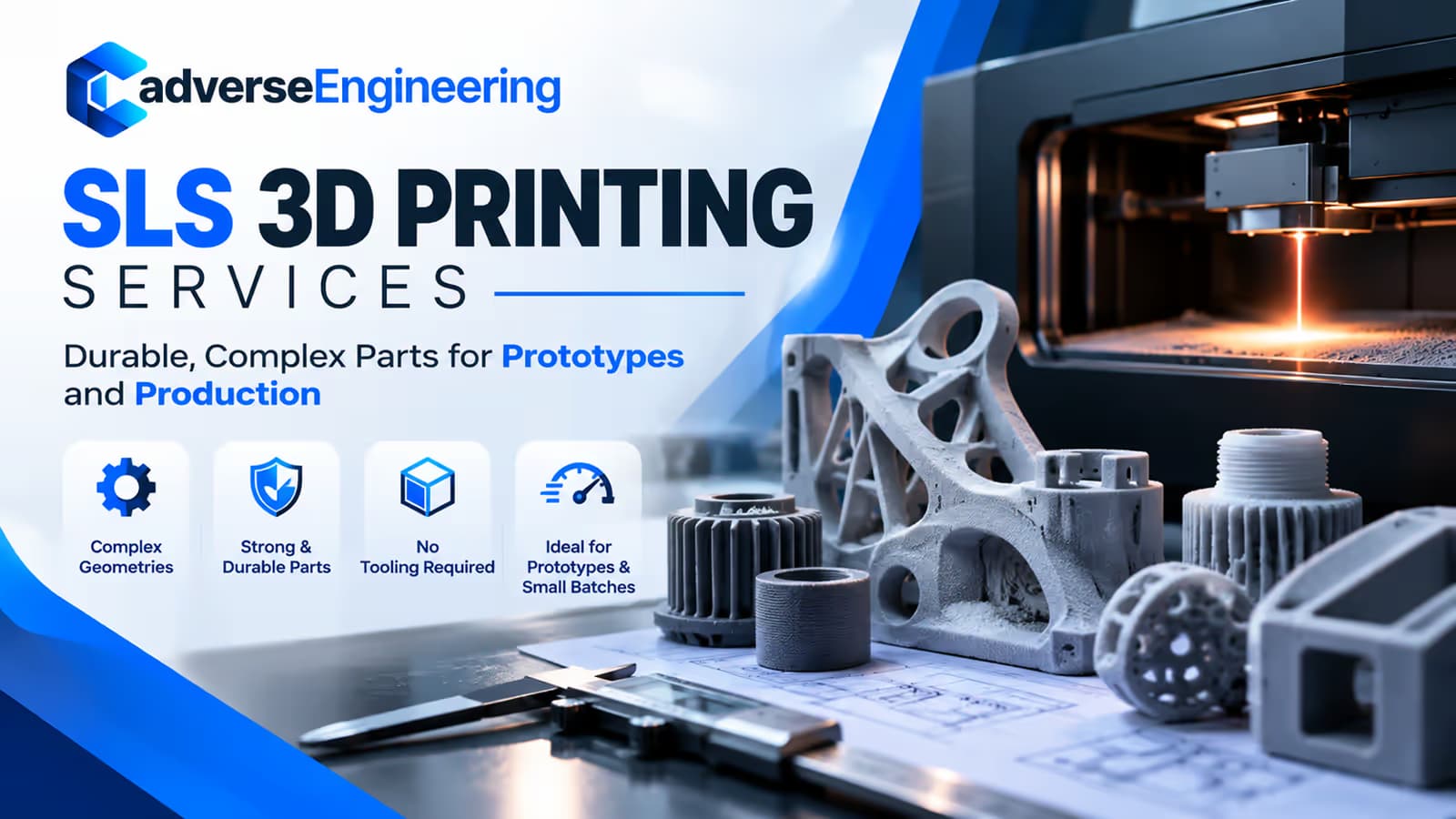
SLS 3D Printing Services for Custom Parts | CAD Verse
SLS 3D Printing Services for Custom Parts | CAD Verse
The creation of a working part from an idea for a product involves selecting the appropriate technology and material and engineering the part. For companies requiring sturdy prototypes, intricate designs, and unique plastic parts without the use of traditional manufacturing tools, SLS 3D printing services prove to be a valuable option.
CAD Verse Engineering offers CAD modelling, prototyping, and manufacturing support services to help businesses take their ideas from concept to reality. From new product development to refining an existing design, or even considering manufacturing possibilities, it can help in making the right decisions for your next design.
What Are SLS 3D Printing Services?
Selective Laser Sintering (SLS) is an additive manufacturing technique that is based on the fusion of small thermoplastic powder particles with a laser beam to form a solid part. The printer creates the part layer by layer on the basis of a digital 3D model.
SLS generally does not need special support structures since the surrounding powder supports the printed part during the printing process. It is extremely suitable for creating complex designs such as internal channels, clips, housings, etc., and intricate shapes.
Digital CAD designs can be converted into physical products that can be inspected, assembled, and tested with professional 3D printing services before entering into larger production runs, helping to support product development.
What Are the Benefits of SLS 3D Printing?
Complex Designs Without the Need for Conventional Tooling
Make complex designs without the need for traditional tooling. The main strength of SLS is its capacity to manufacture complex geometry without the need to use traditional moulds. Engineers can investigate complex shapes, integrated features, and lightweight structures which may be hard or costly to manufacture using traditional methods.
For startups, product designers, and manufacturers creating special parts, this flexibility is useful.
Durable Functional Prototypes
Engineering thermoplastics like nylon are often used to make functional parts that have useful mechanical properties in SLS. These components may be appropriate for fit checks, assembly checks, and some functional checks depending on the material and design chosen.
A business that takes advantage of the 3D printing services that are offered by SLS can test a design in real life before making the more costly investment in manufacturing.
Efficient Small-Batch Production
There may be significant tooling costs before products are actually manufactured using traditional manufacturing methods. For products with evolving design needs, limited production runs, and custom components, consider using SLS to minimize this initial tooling requirement.
The best method to use will depend on part geometry, quantity, material requirements, finishing needs, and the operating environment of the parts.
Common Applications of SLS 3D Printing
SLS technology is used in many product development and engineering applications.
- Product Development: Develop physical prototypes from new product concepts to be reviewed for design and testing.
- Functional Prototypes: Test the fit and assembly of components and some mechanical requirements.
- Custom Enclosures: Design enclosures for electronic devices and specific pieces of equipment.
- Industrial Components: Manufacture brackets, clips, ducts, and other custom plastic components as appropriate.
- Low-Volume Manufacturing: Produce small runs without the need to have traditional mould tooling.
- Complex Geometries: Investigate designs involving different complex features that might not be easily obtained by other means.
By selecting professional SLS 3D printing services, teams can evaluate these applications to decide if SLS is suitable for their products.
SLS Vs. Other 3D Printing Technologies
Not all projects can be printed with the same technique. You can compare technologies available to decide on an appropriate process for the part.
- Type of 3D Printing — SLS — FDM — SLA
- Printing Process — Laser-fused powder — Extruded thermoplastic filament — Light-cured liquid resin
- Common Materials — Nylon and other compatible powders — PLA, ABS, TPU and other compatible filaments — Photopolymer resins
- High-Complexity Design — Good for complex geometry — Dependent on direction and support needs — Accepts a detailed shape, subject to design constraints
- Surface Finish — Slightly textured — Surface lines or layers visible — Fine surface details often visible
- Common Applications — Functional parts and complex prototypes — Functional prototypes and general components — Detailed visual prototypes and models
- Tooling Requirement — No conventional mould required — No conventional mould required — No conventional mould required
What Technology Should You Use?
For complex plastic parts or functional prototypes, SLS can be used. FDM may be used for various generic components, and SLA may be utilized for detailed models and smooth visual surfaces.
The selection should be made based on the specific design, material needs, budget, and desired performance of the structure.
CAD Verse Engineering Is Committed to Helping You With Your Product Development
CAD Verse Engineering is dedicated to assisting you with the development of your product. Choosing a printing process is just one aspect of the product development process. The digital design should also consider the size and shape of parts, assembly, and manufacturing constraints.
- CAD Verse Engineering offers product development assistance based on CAD design, prototyping, and design for manufacturing.
- We emphasize grasping your needs and finding solutions that are both effective and feasible.
Communicate Your Product Idea
Send illustrations, reference photos or existing CAD files or tell of your product. Describe its uses and its intended problem.
Review the Design Requirements
Recognize significant dimensions, anticipated functions, material preferences, and any critical assembly or performance specifications.
Different Manufacturing Options
Each project calls for its own production technique. We can help with the design requirements assessment and other prototyping or manufacturing route discussions.
Create and Improve the Design
CAD modelling and engineering refinement clarify and prepare the design for evaluation of component geometry.
Seeing Into a Future Stage of Production
If the design requirements are now clearer, you might need to perform a prototype test and revise the design or prepare for manufacturing.
When you are thinking about hiring SLS 3D printing services, you should let your project details be shared with the right technical requirements and options for production and discuss them with the service provider before starting work.
What Details Are Required to Get a Quote for SLS 3D Printing?
Communication of your project information assists a service provider in understanding your requirements and enabling them to assess what is next.
If you need to get a quote, gather the following information if possible:
- 3D CAD File: STEP, STL, or other suitable format.
- Part Dimensions: Overall length, width, height, and important features.
- Material Requirements: Preferred material or expected mechanical properties.
- Quantity: The number of items to be prototyped or produced.
- Intended Application: How the component will be used and what conditions it will be exposed to.
- Finishing Requirements: Any preference for surface appearance, colour or post-processing.
If you are not working on a CAD model, describe your idea and provide the references that you have. CAD design support can be useful in determining the geometry and specification requirements prior to manufacturing decisions.
Frequently Asked Questions
What Are SLS 3D Printing Services Used For? The SLS 3D printing services are used to manufacture complex plastic parts, functional prototypes, custom enclosures, and selected low-volume production parts. Applications are dependent on material, geometry, and performance requirements.
Will SLS 3D Printing Work for Functional Prototypes? Yes. SLS can generate working prototypes that can be used to test dimensions, fit, assembly, and mechanical properties. Performance will vary with the material and application.
What Materials Are Typically Used for SLS Printing? Common materials used for SLS include nylon, such as PA12 and PA11 nylon. Availability and properties of the materials depend on the printing system and the supplier.
What Is Better: SLS, FDM or SLA? Not in all cases. SLS can be used for manufactured plastic parts that are not so common, FDM can be used for many common plastic parts, and SLA is often chosen for creating detailed visual plastic parts. The best choice is yours depending on your needs.
What Is the Initial Step to Getting Started With CAD Verse Engineering? Go to the CAD Verse Engineering website and contact them using their available contact methods with your project requirements. Attach your CAD, reference photos, dimensions, quantity, and use, if applicable.
Start Your Next Product Development Project
The first step in creating a successful product is to have a clear design and a manufacturing process that is suitable to the product's needs. SLS technology can offer many opportunities for creating complex plastic parts, prototype testing, and testing low-volume production runs.
CAD Verse Engineering provides CAD modelling, prototyping and design assistance to help with product development for manufacturing. Talk to CAD Verse Engineering about your project, understand your needs, and discover the best path from digital design to physical prototype.
Need help applying this to your product?
Discuss Your Project